Magnetic Effects of Electric Current — Notes
Magnetic Effects of Electric Current
Chapter Overview
An electric current does more than produce a heating effect. A current-carrying conductor also produces a magnetic effect. This chapter develops the idea of magnetic fields and field lines, studies magnetic fields produced by straight conductors, circular loops and solenoids, explains the force on a current-carrying conductor in a magnetic field, and describes domestic electric circuits and electrical safety.
- Magnetic field and magnetic field lines
- Field due to a current-carrying conductor
- Right-hand thumb rule
- Circular loop and solenoid
- Force on a current-carrying conductor
- Fleming's left-hand rule
- Electric motor and other applications
- Domestic circuits, fuse and earthing
1. Magnetic Field and Field Lines
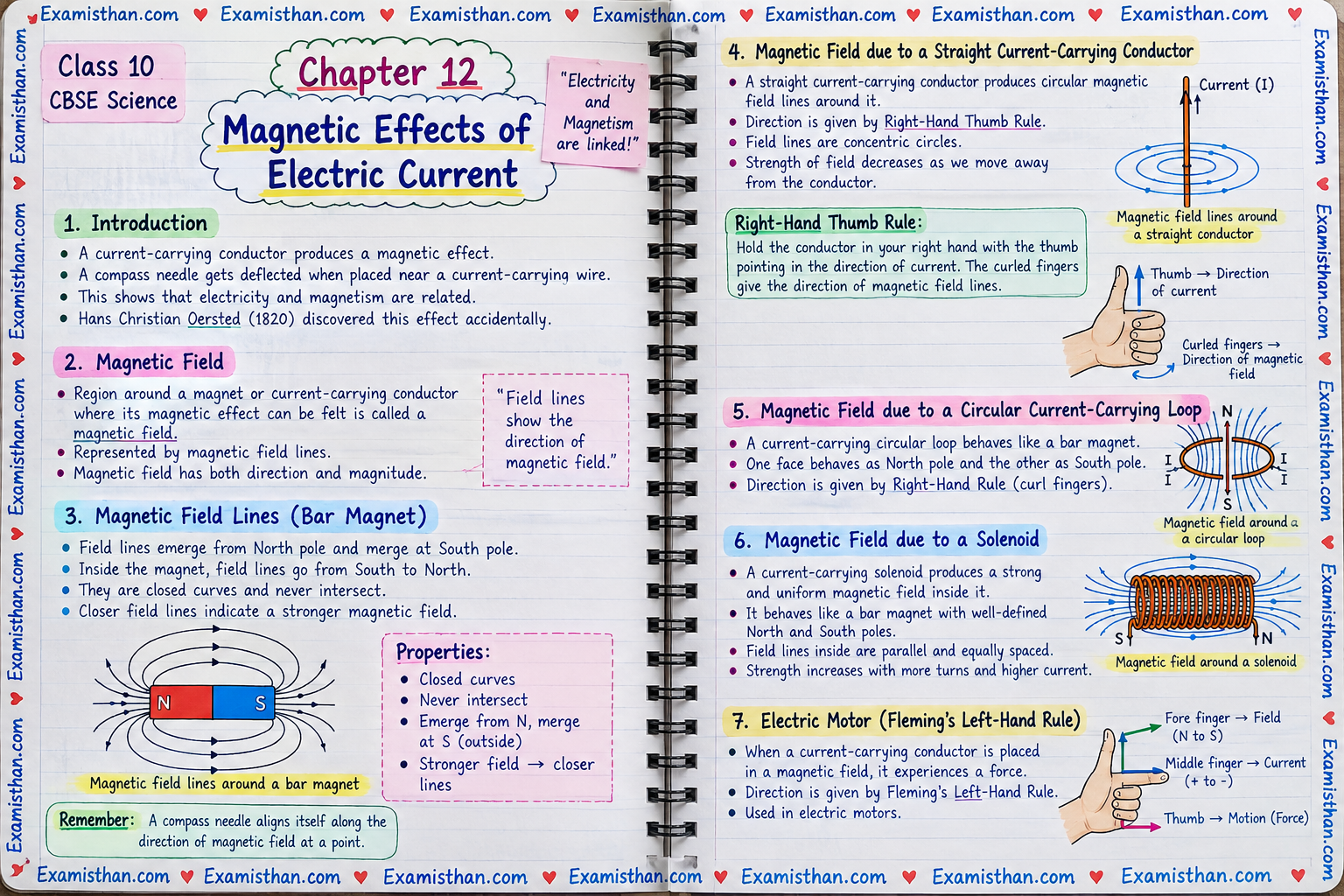
A magnetic field is the region surrounding a magnet in which the force of the magnet can be detected. A compass needle is a small bar magnet, so it changes its direction when placed in a magnetic field.
Magnetic poles
- The end of a compass needle pointing approximately north is called the north-seeking or north pole.
- The other end is the south pole.
- Like poles repel; unlike poles attract.
How field lines are shown
- Iron filings align themselves along the magnetic field pattern.
- The pattern of aligned filings represents magnetic field lines.
- A compass can also be moved step by step to trace a field line.
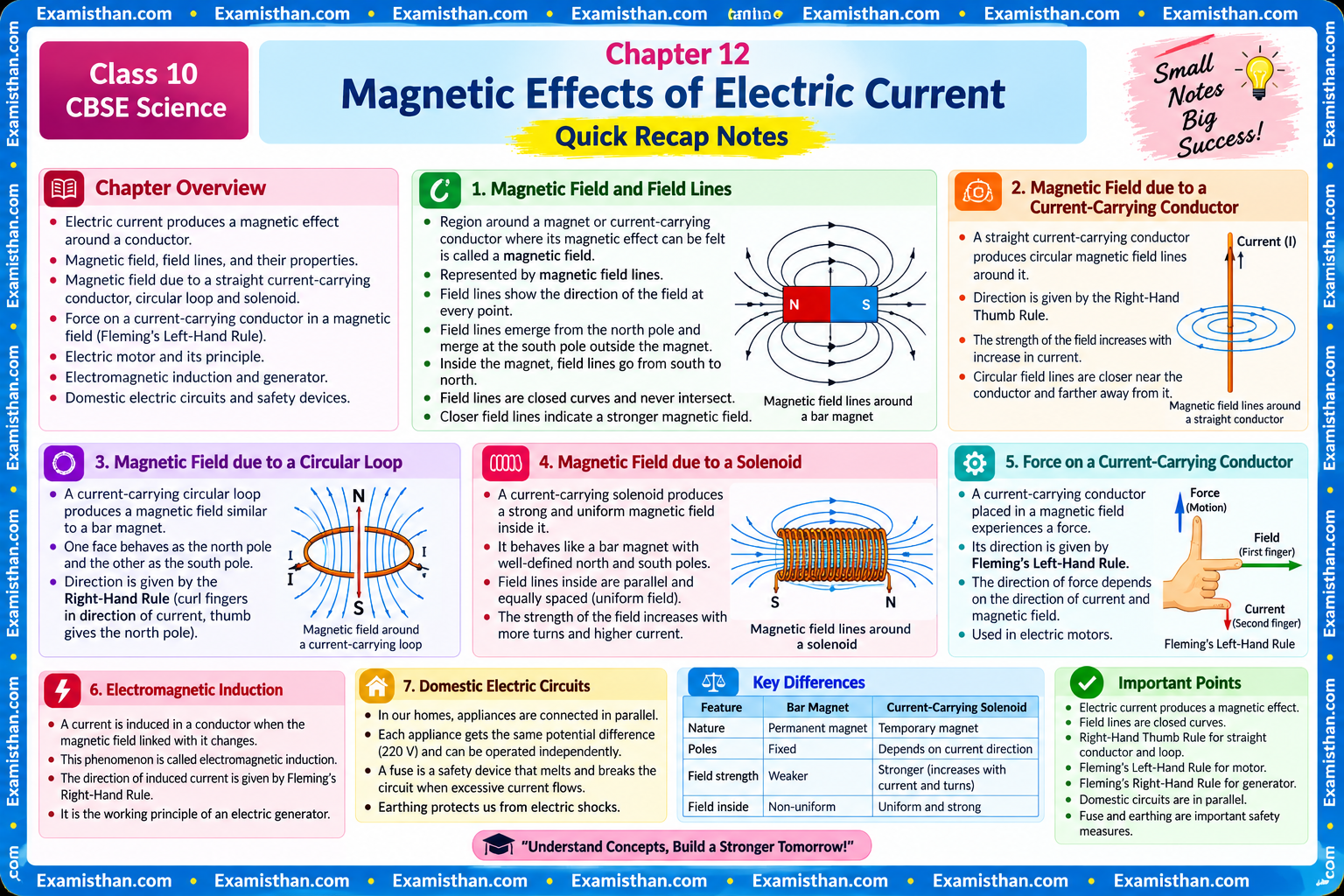
- Outside a bar magnet, field lines emerge from the north pole and merge at the south pole.
- Inside the magnet, field lines go from south to north.
- Therefore, magnetic field lines are closed curves.
- Closer or more crowded field lines indicate a stronger magnetic field.
- No two magnetic field lines cross because a compass needle cannot point in two directions at the same point.
2. Magnetic Field Due to a Current-Carrying Straight Conductor
When electric current passes through a metallic conductor, a magnetic field is produced around it. The chapter demonstrates this effect by observing the deflection of a compass needle placed near a current-carrying wire.
Around a straight current-carrying conductor, magnetic field lines form concentric circles centred on the conductor.
At a given point, increasing the current increases the magnitude of the magnetic field and therefore increases compass deflection.
For a fixed current, the magnetic field decreases as the distance from the conductor increases.
3. Right-Hand Thumb Rule
The right-hand thumb rule is used to determine the direction of the magnetic field associated with a current-carrying conductor.
- Imagine holding the current-carrying straight conductor in your right hand.
- Point your thumb in the direction of current.
- The curled fingers show the direction of the magnetic field lines.
Also called: Maxwell's corkscrew rule. In the corkscrew analogy, if the corkscrew advances in the direction of current, its rotation gives the direction of the magnetic field.
4. Magnetic Field Due to a Current Through a Circular Loop
When a straight current-carrying conductor is bent into a circular loop, every section of the wire contributes to the magnetic field. At the centre of the loop, the contributions from the different sections act in the same direction and add up.
- The arcs of the field circles appear approximately as straight lines at the centre.
- Every section of the loop contributes to the field in the same direction within the loop.
- If a circular coil has n turns, the field produced is n times that produced by a single turn, under the comparison described in the chapter.
- The reason is that the field due to each turn adds in the same direction.
5. Magnetic Field Due to a Current in a Solenoid
A solenoid is a coil of many circular turns of insulated copper wire wrapped closely in the shape of a cylinder.
The magnetic field pattern of a current-carrying solenoid is similar to that of a bar magnet. One end behaves as a north pole and the other as a south pole.
Inside the solenoid, field lines are parallel straight lines, indicating that the magnetic field is uniform inside the solenoid.
6. Force on a Current-Carrying Conductor in a Magnetic Field
A current-carrying conductor placed in a magnetic field experiences a force. In the chapter activity, a current-carrying aluminium rod placed between the poles of a horseshoe magnet is displaced, demonstrating this magnetic force.
Reversing the current reverses the direction of the force and the displacement of the rod.
Reversing the direction of the magnetic field also reverses the direction of the force.
The force is largest when the current is at right angles to the magnetic field.
Stretch the thumb, forefinger and middle finger of your left hand so that they are mutually perpendicular. If the forefinger points in the direction of the magnetic field and the middle finger in the direction of current, the thumb points in the direction of motion or force on the conductor.
Applications mentioned in the chapter: electric motor, electric generator, loudspeakers, microphones and measuring instruments.
7. Direction of Force on a Charged Particle — Chapter Example
The chapter gives an example of an electron entering a magnetic field at right angles. The direction of conventional current is taken opposite to the direction of electron motion, so Fleming's left-hand rule gives the force direction accordingly.
8. Domestic Electric Circuits
The chapter describes the supply of electric power to homes through the main supply, either by overhead electric poles or underground cables. The potential difference between the live and neutral wires is given as 220 V.
The chapter describes it as usually having red insulation.
The chapter describes it as having black insulation.
Usually has green insulation and is connected to a metal plate deep in the earth.
The chapter summary states an AC supply frequency of 50 Hz.
Typical domestic circuits
| Circuit | Typical use described in chapter |
|---|---|
| 15 A | Higher-power appliances such as geysers and air coolers |
| 5 A | Bulbs, fans and similar appliances |
9. Fuse, Short-Circuiting and Overloading
A fuse protects appliances and circuits by stopping the flow of unduly high current. Joule heating melts the fuse and breaks the circuit.
It can occur when the live and neutral wires come into direct contact, causing the current to increase abruptly.
It may result from too many appliances connected to one socket or from an accidental increase in supply voltage.
10. Earthing and Electrical Safety
The earth wire is especially important for appliances with metallic bodies such as an electric press, toaster, table fan and refrigerator. The metallic body is connected to the earth wire.
- The earth wire provides a low-resistance conducting path for leakage current.
- It keeps the metallic body near the potential of the earth.
- This reduces the chance of the user receiving a severe electric shock.
11. Magnetism in Medicine
The chapter explains that electric current also occurs as weak ion currents along nerve cells in the human body. These currents produce very weak magnetic fields.
The chapter describes them as about one-billionth of Earth's magnetic field.
The heart and brain are identified as two organs where the magnetic field produced in the body is significant.
Magnetic Resonance Imaging uses magnetic fields inside the body as the basis for obtaining images used in medical diagnosis.
12. Quick Revision Table
| Topic | Remember |
|---|---|
| Magnetic field | Region around a magnet where magnetic force can be detected. |
| Field-line direction outside magnet | North pole → South pole. |
| Field-line direction inside magnet | South pole → North pole. |
| Straight current-carrying wire | Concentric circular magnetic field lines. |
| Right-hand thumb rule | Thumb = current; curled fingers = magnetic field direction. |
| Circular coil | Field contributions of the turns add in the same direction. |
| Solenoid | Similar magnetic field pattern to a bar magnet; field inside is uniform as described. |
| Fleming's left-hand rule | Forefinger = field; middle finger = current; thumb = force/motion. |
| Domestic appliances | Connected in parallel so each gets equal potential difference and can be controlled independently. |
| Fuse | Melts due to Joule heating when excessive current flows. |
| Earthing | Provides a low-resistance path for leakage current and improves safety. |
| Domestic AC supply | 220 V and 50 Hz, as stated in the chapter summary. |
13. Board Exam Focus
- Properties of magnetic field lines
- Why magnetic field lines never intersect
- Field around a straight current-carrying conductor
- Right-hand thumb rule
- Field due to a circular loop and a solenoid
- Force on a current-carrying conductor
- Fleming's left-hand rule
- Electric motor and other magnetic applications
- Parallel domestic circuits
- Fuse, short circuit, overloading and earthing
Last-Minute Revision
For exam preparation, practise direction-based questions carefully: identify the direction of current, identify the magnetic field direction, and then apply the appropriate rule. Also remember that magnetic field lines are closed curves, do not intersect, and are more crowded where the field is stronger.