Surface Areas and Volumes — Notes
📑 Chapter Navigator
01
12.1 Combination of Solids
A solid may be formed by joining or removing familiar solids such as cuboids, cylinders, cones, hemispheres and spheres. For surface area, count only the surfaces that are actually exposed.
02
12.2 Conversion of Solids
When one solid is melted and recast into another, the volume is conserved, provided there is no loss of material.
Core principle
Volume before = Volume after.
03
12.3 Frustum of a Cone
A frustum is obtained when a cone is cut by a plane parallel to its base. If radii are R and r and slant height is l:
CSA = π(R+r)l
Volume = (1/3)πh(R2+r2+Rr).
CSA = π(R+r)l
Volume = (1/3)πh(R2+r2+Rr).
04
12.4 Important Formulae
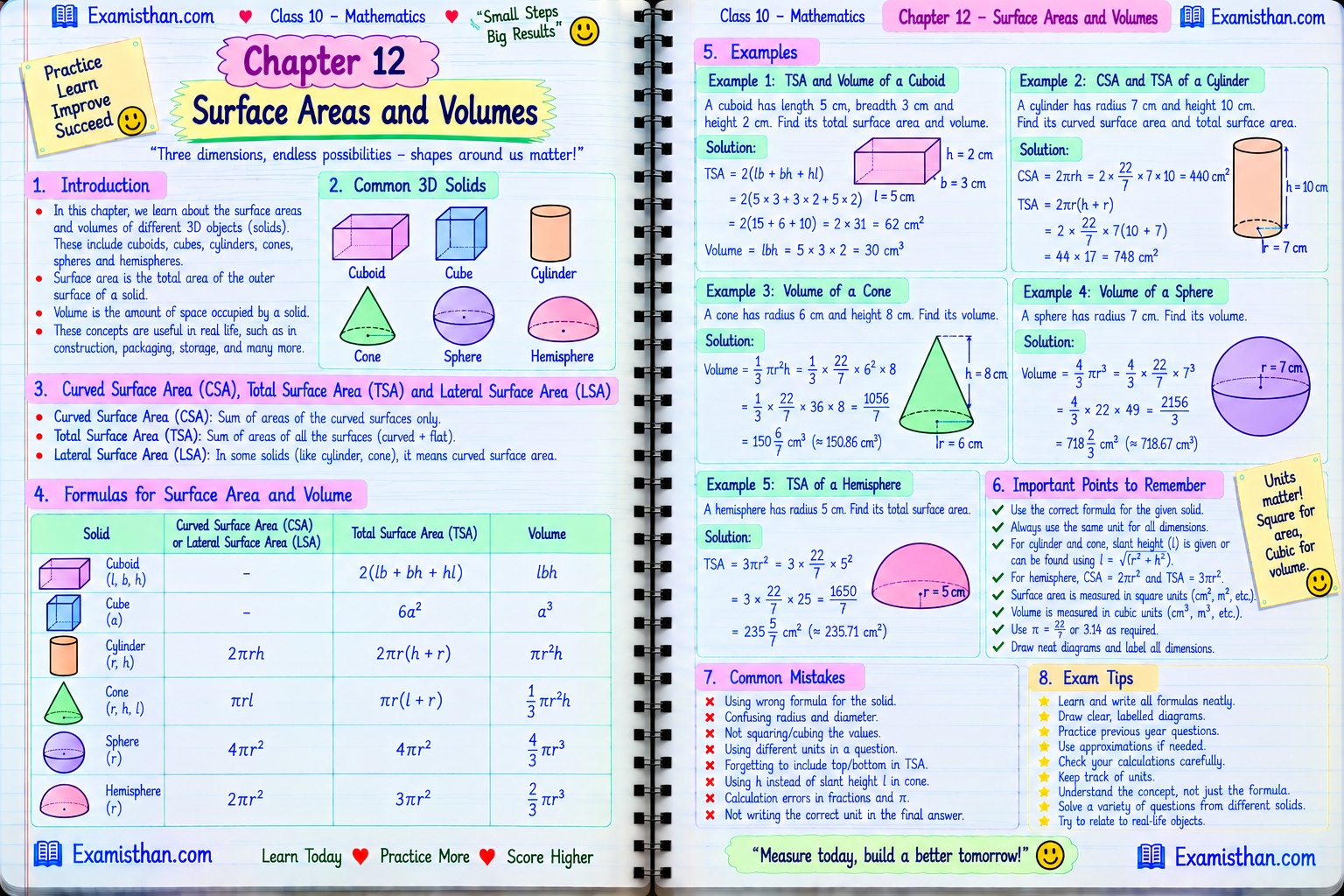
Cylinder: CSA=2πrh, TSA=2πr(h+r), V=πr²h.
Cone: l=√(r²+h²), CSA=πrl, TSA=πr(l+r), V=⅓πr²h.
Sphere: SA=4πr², V=4/3πr³.
Hemisphere: CSA=2πr², TSA=3πr², V=2/3πr³.
Cone: l=√(r²+h²), CSA=πrl, TSA=πr(l+r), V=⅓πr²h.
Sphere: SA=4πr², V=4/3πr³.
Hemisphere: CSA=2πr², TSA=3πr², V=2/3πr³.
05
12.5 Unit Conversion
For volume, remember that 1 cm³ = 1 mL and 1000 cm³ = 1 L. Convert units before applying formulas.
⚡ Quick Revision
- Use exposed surfaces only for total surface area of combinations.
- Recasting → volume conserved.
- Cone slant height l=√(r²+h²).
- Frustum volume = ⅓πh(R²+r²+Rr).
🎯 Board Exam Focus
- Separate CSA, TSA and volume clearly.
- Do not include hidden circular faces in a joined solid.
- Convert all dimensions to one unit before calculating.
🚀 Last-Minute Revision
✔ Read every formula with its conditions and symbols.
✔ Write given data first and keep units consistent.
✔ For proofs, state the theorem and show logical steps.
✔ Check signs, substitutions and final units.
❤️ Examisthan.com • Class 10 CBSE Mathematics • Chapter 12: Surface Areas and Volumes