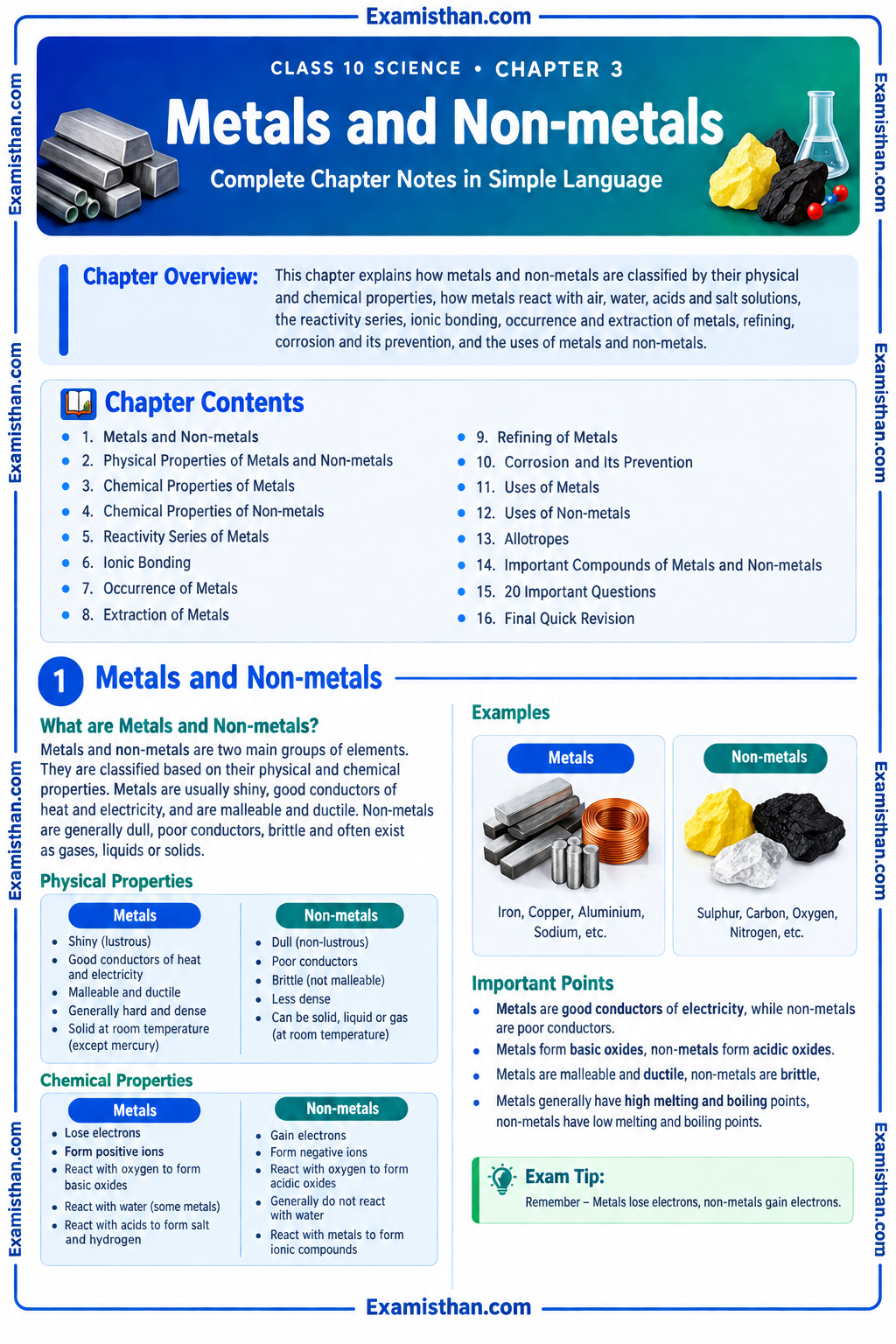
Metals and Non-metals — Notes
Metals and Non-metals
Complete Chapter Notes in Simple Language
📚 Chapter Contents
- Physical Properties of Metals
- Physical Properties of Non-metals
- Reaction of Metals with Air
- Reaction of Metals with Water
- Reaction of Metals with Acids
- Reaction with Salt Solutions
- The Reactivity Series
- How Metals and Non-metals React
- Properties of Ionic Compounds
- Occurrence of Metals
- Extraction of Metals
- Refining of Metals
- Corrosion
- Prevention of Corrosion & Alloys
- 20 Important Questions
1 Physical Properties of Metals
Lustre, Malleability, Ductility
Metals, in their pure state, have a shining surface. This property is called metallic lustre. Metals that can be beaten into thin sheets show malleability, and metals that can be drawn into thin wires show ductility.
Gold → most ductile metal
Hardness, Conductivity and Sonority
- Metals are generally hard, though hardness varies from metal to metal.
- Metals are good conductors of heat and electricity. Silver and copper are the best conductors of heat; lead and mercury are comparatively poor conductors.
- Metals that produce a ringing sound on striking a hard surface are said to be sonorous — this is why school bells are made of metal.
Important Exceptions
- Mercury is the only metal that is liquid at room temperature.
- Gallium and caesium have such low melting points that they can melt on the palm of your hand.
- Iodine is a non-metal but is lustrous.
- Alkali metals (lithium, sodium, potassium) are so soft they can be cut with a knife, and have low densities and low melting points.
- Carbon exists in different forms called allotropes — diamond is the hardest natural substance, while graphite conducts electricity.
2 Physical Properties of Non-metals
There are very few non-metals compared to metals. Examples include carbon, sulphur, iodine, oxygen and hydrogen. Non-metals are either solids or gases, except bromine, which is a liquid.
| Property | Metals | Non-metals |
|---|---|---|
| Malleability / Ductility | Yes | No, generally brittle |
| Conductivity | Good conductors | Poor conductors (except graphite) |
| Sonority | Sonorous | Not sonorous |
3 Reaction of Metals with Air (Oxygen)
4Al + 3O2 → 2Al2O3
Amphoteric Oxides
Metal oxides are generally basic. But some oxides, such as aluminium oxide and zinc oxide, react with both acids and bases — these are called amphoteric oxides.
Al2O3 + 2NaOH → 2NaAlO2 + H2O
Reactivity Towards Oxygen
- Potassium and sodium react so vigorously that they can catch fire in the open — hence stored under kerosene oil.
- Magnesium, aluminium, zinc and lead form a protective thin oxide layer that prevents further oxidation.
- Iron does not burn on heating, but iron filings burn vigorously when sprinkled in a flame.
- Copper does not burn but forms a black coat of copper(II) oxide.
- Silver and gold do not react with oxygen even at high temperatures.
4 Reaction of Metals with Water
| Metal | Reaction with Water |
|---|---|
| Sodium, Potassium | React violently & exothermically with cold water; evolved H2 catches fire |
| Calcium | Reacts with cold water, less violently; floats due to H2 bubbles |
| Magnesium | No reaction with cold water; reacts with hot water |
| Aluminium, Iron, Zinc | React only with steam, giving metal oxide + H2 |
| Lead, Copper, Silver, Gold | Do not react with water at all |
3Fe(s) + 4H2O(g) → Fe3O4(s) + 4H2(g)
5 Reaction of Metals with Acids
The reactivity order observed with dilute acids (fastest to slowest) is:
Copper does not react with dilute HCl at all — no bubbles form and there is no temperature change.
6 Reaction with Salt Solutions — Displacement
Reactive metals can displace less reactive metals from their compounds in solution.
(only if A is more reactive than B)
Example: an iron nail placed in copper sulphate solution shows the blue colour fading as copper is displaced and deposited on the nail — proving iron is more reactive than copper. A copper wire in iron sulphate solution shows no reaction.
7 The Reactivity Series
The reactivity series lists common metals in order of decreasing chemical activity.
- Metals above hydrogen can displace hydrogen from dilute acids.
- Metals below hydrogen (copper, silver, gold) cannot displace hydrogen from dilute acids.
- A more reactive metal displaces a less reactive one from its salt solution.
8 How do Metals and Non-metals React?
Elements react to attain a completely filled valence shell (noble gas configuration). Metals achieve this by losing electrons to form cations; non-metals achieve this by gaining electrons to form anions.
Formation of Sodium Chloride
Cl + e− → Cl− (chloride anion)
Sodium and chloride ions, being oppositely charged, attract each other by strong electrostatic forces to form NaCl. Sodium chloride does not exist as individual molecules but as aggregates of oppositely charged ions.
Formation of Magnesium Chloride
2Cl + 2e− → 2Cl−
9 Properties of Ionic Compounds
| Property | Ionic Compounds |
|---|---|
| Physical nature | Solid, hard, and brittle (breaks under pressure) |
| Melting/Boiling points | High — strong inter-ionic attraction needs a lot of energy to break |
| Solubility | Soluble in water; insoluble in kerosene, petrol, etc. |
| Conduction (solid) | Do NOT conduct — ions cannot move in the rigid structure |
| Conduction (molten/solution) | DO conduct — ions become free to move |
10 Occurrence of Metals
The earth's crust is the major source of metals; seawater also contains soluble salts like sodium chloride and magnesium chloride.
- Mineral — an element/compound occurring naturally in the earth's crust.
- Ore — a mineral from which a metal can be profitably extracted.
- Gangue — impurities (soil, sand) mixed with the ore.
| Reactivity | Occurrence |
|---|---|
| Top of series (K, Na, Ca, Mg, Al) | Never found free — too reactive |
| Middle of series (Zn, Fe, Pb) | Found as oxides, sulphides or carbonates |
| Bottom of series (Cu, Ag, Au) | Often found free/native |
11 Extraction of Metals
Metals Low in Reactivity
Their oxides can be reduced by heating alone.
Metals in the Middle of the Series
Their sulphide/carbonate ores must first be converted to oxides:
- Roasting — heating a sulphide ore strongly in excess air.
- Calcination — heating a carbonate ore strongly in limited air.
ZnCO3 → ZnO + CO2 (calcination)
ZnO + C → Zn + CO
Metals High in Reactivity
Obtained by electrolytic reduction of their molten compounds, since carbon cannot reduce their oxides.
At anode: 2Cl− → Cl2 + 2e−
12 Refining of Metals
The most widely used method for refining impure metals is electrolytic refining.
- Anode — impure metal
- Cathode — thin strip of pure metal
- Electrolyte — solution of the metal salt (e.g. acidified copper sulphate for copper)
13 Corrosion
- Silver reacts with sulphur in air, forming a black coating of silver sulphide.
- Copper reacts with moist CO2, forming a green coat of basic copper carbonate.
- Iron forms a brown, flaky coating called rust when exposed to moist air.
14 Prevention of Corrosion & Alloys
Preventing Rust
Painting, oiling, greasing, galvanising (coating with zinc), chrome plating, anodising, or making alloys.
Alloys
An alloy is a homogeneous mixture of two or more metals, or a metal and a non-metal.
| Alloy | Composition | Use |
|---|---|---|
| Stainless steel | Iron + Nickel + Chromium | Hard, rust-resistant |
| Brass | Copper + Zinc | Fittings, decorative items |
| Bronze | Copper + Tin | Statues, utensils |
| Solder | Lead + Tin | Welding electrical wires (low melting point) |
15 20 Important Questions for Exam Preparation
- What is metallic lustre? Give two examples of malleable metals.
- Explain the meanings of malleable and ductile with examples.
- Give an example of a metal that (i) is a liquid at room temperature (ii) can be cut with a knife.
- What are amphoteric oxides? Give two examples.
- Write balanced equations for the reaction of iron with steam and calcium with water.
- Why is sodium kept immersed in kerosene oil?
- Why does hydrogen gas not evolve when a metal reacts with nitric acid?
- Name two metals which will displace hydrogen from dilute acids, and two which will not.
- What is a displacement reaction? Give one example.
- What is the reactivity series? Why is hydrogen included in it?
- Explain, with an example, how an ionic compound like sodium chloride is formed.
- Why do ionic compounds have high melting points?
- Define the terms: (i) Mineral (ii) Ore (iii) Gangue.
- What is roasting? What is calcination? Give one equation for each.
- What is the thermit reaction? Where is it used?
- In electrolytic refining of a metal M, what would you take as the anode, cathode and electrolyte?
- State two ways to prevent the rusting of iron.
- What are alloys? Give two examples with their composition and uses.
- Why is copper used to make hot water tanks and not steel?
- Give reasons: (i) Platinum, gold and silver are used to make jewellery. (ii) Aluminium is highly reactive yet used for cooking utensils.
✓ Final Quick Revision
Lustre, malleability, ductility, hardness, sonority, good conductors — with mercury (liquid), gallium/caesium (low melting) and iodine (lustrous non-metal) as key exceptions.
Metal + O2 → Metal oxide (basic, or amphoteric for Al2O3/ZnO).
Metal + Water → Oxide/Hydroxide + H2; Metal + Dilute Acid → Salt + H2.
K > Na > Ca > Mg > Al > Zn > Fe > Pb > [H] > Cu > Hg > Ag > Au
Metal loses electrons (cation); non-metal gains electrons (anion); held by electrostatic attraction.
Low reactivity → heating; Medium → roasting/calcination + reduction; High → electrolysis.
Needs both air + water; prevented by painting, oiling, galvanising, alloying.
Stainless steel (Fe+Ni+Cr), Brass (Cu+Zn), Bronze (Cu+Sn), Solder (Pb+Sn), Amalgam (contains Hg).
Must-Memorise Chemical Equations
2Cu + O2 → 2CuO
2Na + 2H2O → 2NaOH + H2 + heat
Mg + 2HCl → MgCl2 + H2
Fe + CuSO4 → FeSO4 + Cu
2ZnS + 3O2 → 2ZnO + 2SO2
ZnO + C → Zn + CO
Fe2O3 + 2Al → 2Fe + Al2O3 + Heat
Na → Na+ + e− Cl + e− → Cl−
Class 10 Science — Chapter 3
Metals and Non-metals
Complete Revision Notes