Life Processes — Notes
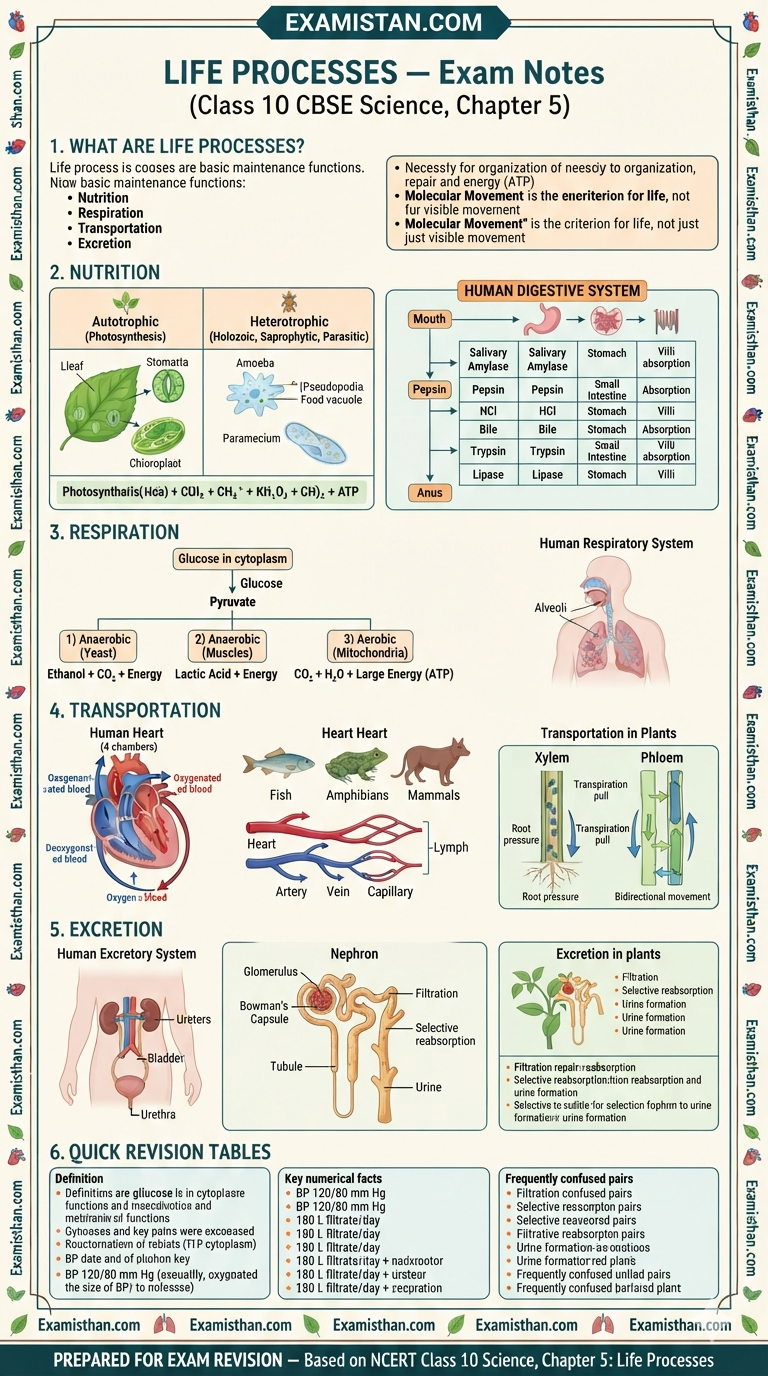
Life Processes
Class 10 · CBSE Science · Chapter 5 — Exam Preparation Notes
Contents
1. What Are Life Processes?
Life processes = the basic maintenance functions performed by living organisms even when they are not doing anything in particular (e.g. even while asleep), needed to keep the organism's ordered, organised structure from breaking down.
Why are life processes necessary?
- Living structures are well organised (tissues → cells → smaller components) and this order tends to break down over time due to the environment.
- Repair and maintenance require energy, which must come from outside the body — this is nutrition.
- Energy sources need to be broken down using oxygen (usually) — this is respiration.
- Materials must reach every cell — this is transportation.
- Harmful waste by-products must be removed — this is excretion.
The five essential life processes covered in this chapter: Nutrition, Respiration, Transportation, Excretion (and Control & Coordination is covered in the next chapter).
Exam tip
A common question is "Is movement enough to prove something is alive?" Answer: No — invisible molecular movement inside cells is the real criterion. Viruses show no molecular movement unless inside a host cell — hence the debate on whether they are "alive".
2. Nutrition
Nutrition = the process of taking in food (energy + raw materials) from outside the body and using it for growth, repair, and energy.
| Feature | Autotrophic Nutrition | Heterotrophic Nutrition |
|---|---|---|
| Food source | Simple inorganic substances (CO₂ + H₂O) | Complex organic substances made by other organisms |
| Organisms | Green plants, some bacteria | Animals, fungi |
| Dependence | Self-sufficient (independent) | Depends directly/indirectly on autotrophs |
| Example | Photosynthesis | Digestion in humans, saprophytic fungi |
2A. Autotrophic Nutrition — Photosynthesis
Photosynthesis: process by which autotrophs convert CO₂ and water into carbohydrates, using sunlight and chlorophyll.
Three key events of photosynthesis
- Absorption of light energy by chlorophyll.
- Conversion of light energy to chemical energy + splitting of water into H and O.
- Reduction of CO₂ to carbohydrates.
Note: These steps need not happen immediately one after another — desert plants take up CO₂ at night (to save water) and use it during the day when light energy is available.
Raw materials needed & their source
- CO₂ — via stomata (leaves), also stems & roots
- Water — absorbed by roots from soil
- Chlorophyll — present in chloroplasts
- Sunlight — energy source
- Minerals (N, P, Fe, Mg) — taken up from soil as nitrates/nitrites
Key structures
- Stomata — tiny pores for gas exchange; opening/closing controlled by guard cells (swell with water → open; shrink → close)
- Chloroplasts — green cell organelles containing chlorophyll
- Starch = storage form of extra glucose in plants (test with iodine → blue-black)
Important Activities (NCERT)
- Activity 5.1 — variegated leaf + iodine test → shows chlorophyll is essential for starch formation (only green parts turn blue-black).
- Activity 5.2 — bell jar + KOH (absorbs CO₂) → shows CO₂ is essential for photosynthesis.
2B. Heterotrophic Nutrition
| Type | Description | Examples |
|---|---|---|
| Saprophytic | Breaks down food outside the body, then absorbs it | Bread mould, yeast, mushrooms |
| Holozoic | Takes in whole food material, digests it internally | Amoeba, humans |
| Parasitic | Derives nutrition from a living host without immediately killing it | Cuscuta (amar-bel), ticks, lice, leeches, tapeworms |
Nutrition in unicellular organisms
- Amoeba — uses temporary finger-like pseudopodia to engulf food → forms a food vacuole → digestion inside vacuole → undigested matter thrown out at cell surface.
- Paramoecium — has a fixed shape; cilia move food to a specific spot on the cell for ingestion.
2C. Nutrition in Human Beings
The alimentary canal is a long tube from mouth to anus, with specialised regions.
Associated glands: Salivary glands, Liver (+ Gall bladder), Pancreas.
| Region | Secretion | Enzyme(s) | Action |
|---|---|---|---|
| Mouth | Saliva (salivary glands) | Salivary amylase | Starch → simple sugar |
| Stomach | Gastric juice (gastric glands) | HCl (creates acidic medium), Pepsin, Mucus | Pepsin digests proteins; HCl activates pepsin & kills germs; mucus protects stomach lining |
| Small intestine | Bile (from liver, stored in gall bladder) | Bile salts (not an enzyme) | Makes acidic food alkaline; emulsifies fats (breaks into smaller globules) |
| Small intestine | Pancreatic juice (from pancreas) | Trypsin, Lipase | Trypsin: proteins → peptides; Lipase: emulsified fats → fatty acids + glycerol |
| Small intestine | Intestinal juice (wall glands) | Various enzymes | Proteins → amino acids; carbohydrates → glucose; fats → fatty acids + glycerol (final conversion) |
Absorption & Egestion
- Villi — finger-like projections in small intestine wall; increase surface area for absorption; richly supplied with blood vessels.
- Large intestine — absorbs excess water from unabsorbed food.
- Waste removed via anus, regulated by the anal sphincter.
- Herbivores (grass-eaters) need a longer small intestine (to digest cellulose); carnivores (meat-eaters) have a shorter one.
3. Respiration
Respiration = process of breaking down food (glucose) to release energy, usually using oxygen from outside the body.
Glucose (6-C) → Pyruvate (3-C) + small amount of energy
| Condition | Location | Products | Type | Example organism |
|---|---|---|---|---|
| Absence of oxygen (in yeast) | Cytoplasm | Ethanol + CO₂ + Energy | Anaerobic (fermentation) | Yeast |
| Lack of oxygen (in muscles) | Cytoplasm | Lactic acid + Energy | Anaerobic | Human muscle cells (causes cramps) |
| Presence of oxygen | Mitochondria | CO₂ + H₂O + large amount of Energy | Aerobic | Most organisms (humans, plants) |
Key comparison — Aerobic vs Anaerobic
Aerobic respiration releases much more energy than anaerobic respiration because glucose is completely broken down to CO₂ and H₂O (vs. partial breakdown to ethanol/lactic acid).
ATP — the energy currency
- Energy released during respiration is used to make ATP from ADP + inorganic phosphate.
- Breaking the terminal phosphate bond of ATP (using water) releases ≈30.5 kJ/mol — used to drive endothermic reactions in the cell (muscle contraction, protein synthesis, nerve conduction, etc.)
Human Respiratory System
- Alveoli — balloon-like structures; thin walls with rich blood supply; huge surface area (~80 m²) for efficient gas exchange.
- Breathing in: ribs lift + diaphragm flattens → chest cavity enlarges → air rushes in.
- A residual volume of air always remains in lungs — allows enough time for O₂ absorption & CO₂ release.
- Haemoglobin (in RBCs) — respiratory pigment, high affinity for O₂; necessary because diffusion alone is too slow to supply O₂ to all cells in large animals.
- CO₂ — more soluble in water than O₂ → transported mostly in dissolved form in blood plasma.
Aquatic vs Terrestrial breathing
Water has much less dissolved O₂ than air → aquatic animals (fish) breathe much faster than terrestrial animals; fish use gills to extract dissolved oxygen from water passed over them.
4. Transportation
4A. Transportation in Human Beings
Blood = fluid connective tissue; plasma (fluid) + suspended cells.
- Plasma — transports food, CO₂, nitrogenous waste (dissolved form)
- RBCs (Red blood corpuscles) — carry oxygen (via haemoglobin)
- Platelets — help blood clotting at injury sites
Heart — structure & working
Right Atrium (receives deoxygenated blood from body) → Right Ventricle (pumps deoxygenated blood to lungs)
- Ventricles have thicker walls than atria (must pump blood over longer distances/against more resistance).
- Valves prevent backflow of blood.
- Separation of oxygenated & deoxygenated blood → efficient O₂ supply → important for animals (birds, mammals) that maintain constant body temperature using energy.
| Animal group | Heart chambers | Mixing of blood |
|---|---|---|
| Fish | 2 chambers | No mixing; blood passes through heart once per cycle (single circulation) |
| Amphibians / many reptiles | 3 chambers | Some mixing of oxygenated & deoxygenated blood |
| Birds & mammals | 4 chambers | No mixing; double circulation (blood passes through heart twice per cycle) |
Blood Vessels
| Vessel | Direction | Wall | Special feature |
|---|---|---|---|
| Arteries | Away from heart | Thick, elastic | Blood under high pressure |
| Veins | Towards heart | Thin | Have valves to prevent backflow (low pressure) |
| Capillaries | Between artery & vein | One cell thick | Site of exchange of materials with cells |
Blood Pressure
Systolic pressure (ventricles contract) ≈ 120 mm Hg; Diastolic pressure (ventricles relax) ≈ 80 mm Hg. Measured by sphygmomanometer. High BP (hypertension) → arteriole constriction → risk of artery rupture/internal bleeding.
Lymph
Colourless fluid, similar to plasma but less protein; formed when plasma/proteins/cells leak through capillary walls into intercellular spaces. Function: carries digested fat from intestine; drains excess fluid back into blood.
4B. Transportation in Plants
| Feature | Xylem | Phloem |
|---|---|---|
| Transports | Water & minerals (roots → leaves) | Food/sugars (leaves → other parts) — translocation |
| Direction | Unidirectional (upward) | Bidirectional (up & down, as needed) |
| Mechanism | Mostly passive — root pressure + transpiration pull | Active — uses ATP energy to move sucrose, creating osmotic pressure gradient |
| Cell types | Vessels & tracheids | Sieve tubes + companion cells |
Movement of water — key terms
- Root pressure — active uptake of ions at root creates concentration gradient → water moves into root; more important at night.
- Transpiration — loss of water vapour from aerial parts (mainly through stomata).
- Transpiration pull — evaporation from leaf cells creates suction pulling water up through xylem; major driving force during the day (stomata open).
- Functions of transpiration: absorption & upward movement of water/minerals + temperature regulation.
5. Excretion
Excretion = removal of harmful metabolic (nitrogenous) waste products from the body.
Excretion in Human Beings
- Basic filtration unit = Nephron (many packed in each kidney).
- Glomerulus — cluster of thin-walled capillaries.
- Bowman's capsule — cup-shaped structure collecting the filtrate from the glomerulus.
- Useful substances (glucose, amino acids, salts, most water) are selectively re-absorbed along the tubule.
- Nitrogenous wastes removed: urea or uric acid.
- Initial filtrate ≈ 180 L/day; actual urine excreted ≈ 1–2 L/day (rest reabsorbed).
Artificial Kidney (Hemodialysis)
Used when kidneys fail. Blood passed through tubes with a selectively permeable membrane, suspended in dialysing fluid (same osmotic pressure as blood, but no nitrogenous waste). Waste diffuses out of blood into fluid. Key difference from natural kidney: no re-absorption occurs in dialysis.
Excretion in Plants
- O₂ (from photosynthesis) can itself be considered a waste product.
- Excess water removed via transpiration.
- Other wastes stored in cellular vacuoles, or as resins & gums (especially in old xylem), or shed with falling leaves, or excreted into surrounding soil.
6. Quick Revision Tables
| Process | One-line definition |
|---|---|
| Nutrition | Intake & utilisation of food for energy and growth |
| Respiration | Breakdown of food to release energy (as ATP) |
| Transportation | Movement of food, O₂, CO₂, and waste to/from all cells |
| Excretion | Removal of harmful metabolic (nitrogenous) wastes from the body |
| Fact | Value |
|---|---|
| ATP terminal phosphate bond energy | ≈ 30.5 kJ/mol |
| Normal blood pressure | 120/80 mm Hg (systolic/diastolic) |
| Alveolar surface area (approx.) | ≈ 80 m² |
| Kidney initial filtrate (per day) | ≈ 180 L |
| Urine actually excreted (per day) | ≈ 1–2 L |
Frequently confused pairs — quick check
- Trypsin vs Pepsin — Trypsin (pancreas, small intestine) vs Pepsin (stomach); both digest proteins but at different sites/pH.
- Root pressure vs Transpiration pull — root pressure dominant at night; transpiration pull dominant during the day.
- Xylem vs Phloem transport — xylem = passive, one-way (up); phloem = active (uses ATP), two-way.
- Aerobic vs Anaerobic respiration — aerobic needs O₂, occurs in mitochondria, releases much more energy.