How do Organisms Reproduce — Notes
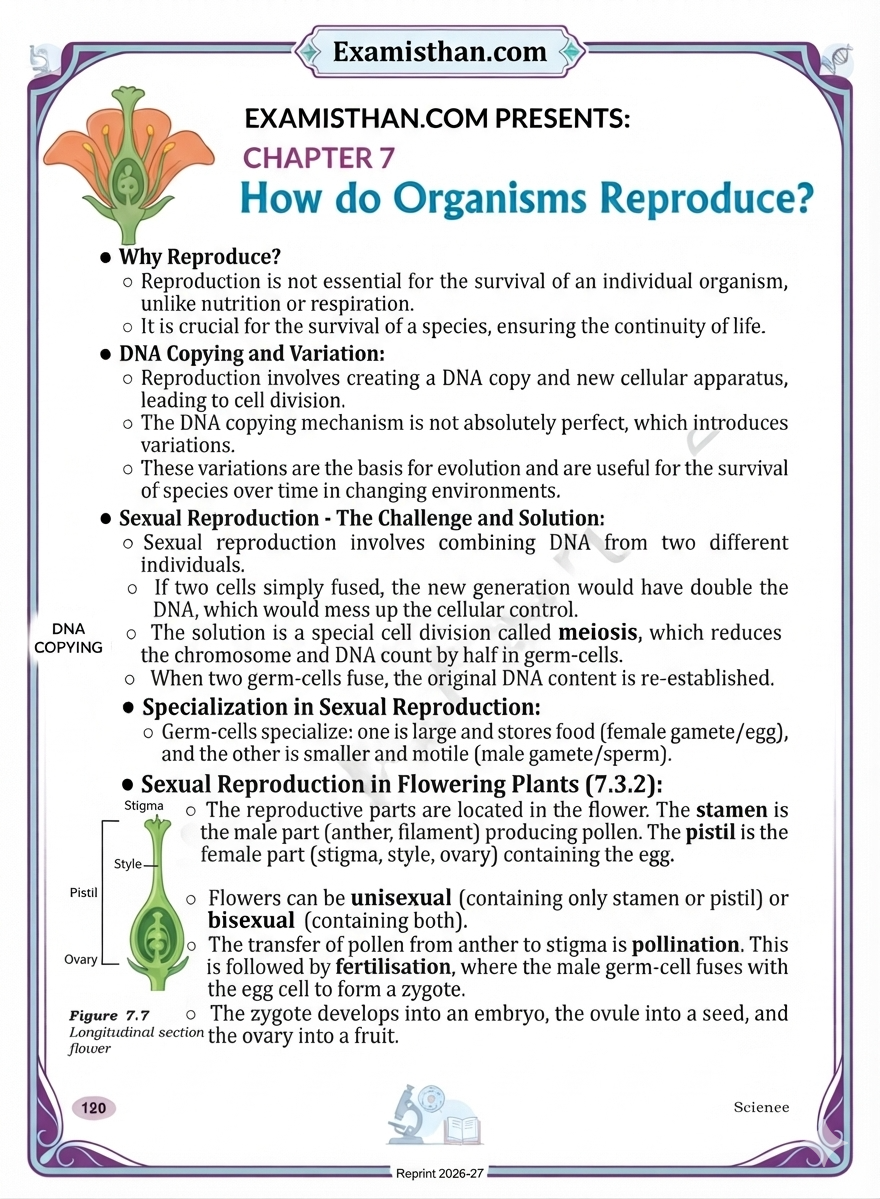
Chapter 7: How do Organisms Reproduce?
7.1 Why do organisms reproduce?
- Reproduction is not necessary to maintain the life of an individual organism (unlike essential processes like nutrition, respiration, or excretion).
- It is the process by which individuals create more individuals of their own kind.
- It is important for the survival of a species over time, ensuring its continuity.
7.2 Do organisms create exact copies of themselves?
- Basis of Similarity: Organisms look similar because their body designs are similar.
- Blueprints of Design: For designs to be similar, the blueprints must be similar. The fundamental blueprint is DNA (Deoxyribo Nucleic Acid) in the cell nucleus.
- DNA Copying: Reproduction at the basic level involves making copies of DNA. This process is accompanied by the creation of additional cellular apparatus so that a cell divides into two.
- Variations: The DNA copying process is not absolutely accurate. Small inaccuracies lead to variations in the DNA copies.
- Significance of Variation:
- Most variations are harmless or even helpful, but some can be drastic, leading to the death of the new cell.
- Variations are the basis for evolution.
- They are useful for the survival of species over time, allowing them to adapt to changing environmental conditions.
7.3 Modes of Reproduction used by Single Organisms
This type of reproduction, where a new generation is created from a single individual, is called asexual reproduction. Several modes exist:
1. Fission
- Unicellular organisms split to create new individuals.
- Binary Fission: Splits into two equal halves (e.g., Amoeba - in any plane, Leishmania - in a definite orientation).
- Multiple Fission: Splits into many daughter cells simultaneously (e.g., Plasmodium - malarial parasite).
2. Fragmentation
Simple multi-cellular organisms break up into smaller pieces (fragments) upon maturation, and each fragment grows into a new individual (e.g., Spirogyra).
3. Regeneration
- The ability of a fully differentiated organism to give rise to new individual organisms from its body parts if cut or broken (e.g., Hydra, Planaria).
- This is different from reproduction, as most organisms are not normally cut up to reproduce.
4. Budding
A new individual develops as an outgrowth (bud) due to repeated cell division at a specific site. This bud detaches when mature (e.g., Hydra, Yeast).
5. Vegetative Propagation
- New plants develop from vegetative parts like the root, stem, and leaves.
- Artificial Methods: Techniques like layering or grafting are used in agriculture.
- Advantages: Plants can bear flowers/fruits earlier than those from seeds and allow propagation of seedless plants.
- Tissue Culture: A modern technique to grow new plants from separated cells or tissue in an artificial medium.
6. Spore Formation
- Common in simple multi-cellular organisms (e.g., Rhizopus - bread mould).
- The reproductive part is a sporangium, which contains cells called spores.
- Spores are covered by thick walls that protect them until they land on a moist surface and can grow.
7.4 Sexual Reproduction
- This mode depends on the involvement of two individuals (males and females) to create a new generation.
- It incorporates the process of combining DNA from two different individuals during reproduction.
- The Challenge: If two DNA copies simply combined, the new generation would have twice the amount of DNA.
- The Solution (Meiosis): Complex organisms solve this by having special lineages of cells in specialized organs that undergo a type of cell division called meiosis.
- When these germ-cells combine to form a zygote, the original number of chromosomes and DNA content is re-established.
- Specialization of Germ-cells: One is large and stores food (female gamete/egg), while the other is smaller and motile (male gamete/sperm).
- Significance: Sexual reproduction allows for greater variation to be generated.
7.5 Sexual Reproduction in Flowering Plants
- Reproductive parts are located in the flower.
- Parts of a Flower: Sepals, petals, stamens, and pistil.
- Stamen (Male Part): Produces yellowish pollen grains, which contain the male germ-cells.
- Pistil (Female Part): Consists of Stigma, Style, and Ovary.
- Unisexual vs. Bisexual:
- Unisexual: Contains either stamen or pistil.
- Bisexual: Contains both stamen and pistil.
- Process of Pollination & Fertilisation:
- Pollination: Transfer of pollen grains from the stamen to the stigma.
- Fertilisation: The pollen tube grows to the ovary and fuses with the female germ-cell to form a zygote.
- Seed & Fruit Formation: The zygote divides to form an embryo, the ovule becomes a seed, and the ovary forms a fruit.
7.6 Reproduction in Human Beings
- Humans use a sexual mode of reproduction.
- Puberty: The period of sexual maturation during adolescence.
- Male Reproductive System:
- Produces germ-cells (sperms) and delivers them to the site of fertilisation.
- Testes: Produce sperms and the hormone testosterone.
- Vas Deferens: A tube that delivers sperms.
- Glands like the prostate and seminal vesicles add secretions.
- Female Reproductive System:
- Produces female germ-cells (eggs/ova).
- Ovaries: Produce eggs and some hormones.
- Oviduct (Fallopian Tube): Carries the egg to the womb.
- Uterus: The structure where the embryo develops.
- Fertilisation & Development:
- The fertilised egg (zygote) divides into an embryo.
- Placenta: Provides nutrition and oxygen to the developing embryo.
- The gestation period takes approximately nine months.
- What happens when the egg is not fertilised: The uterus lining breaks and comes out as blood and mucous in a cycle called menstruation.
7.7 Reproductive Health
- Reproductive health implies that the body and mind are ready for sexual acts and having children.
- Sexually Transmitted Diseases (STDs): Some diseases can be sexually transmitted. Using a condom can help prevent transmission.
- Contraception: Methods used to avoid unwanted pregnancy.
- Mechanical Barrier: Prevents sperm from reaching the egg.
- Hormonal Balance Change: Drugs or pills that prevent egg release.
- Surgical Methods: Creates a block in reproductive tubes.
- Social Issues: Sex-selective abortion is prohibited by law.
- Population & Living Standards: Poor living standards are often linked to inequality in society.
Key Takeaways (What you have learnt)
- Reproduction is not essential for individual life but for species continuity.
- It involves DNA copying and cellular apparatus creation.
- Modes include fission, fragmentation, regeneration, budding, vegetative propagation, and spore formation.
- Asexual reproduction creates new generations from a single individual.
- Sexual reproduction requires two individuals and creates variations.
- Flowering plants reproduce through pollination and fertilisation.
- Puberty changes are signs of sexual maturation.
- Human reproductive systems produce germ-cells and nurture the embryo.
- Contraception helps avoid unwanted pregnancy; condoms offer partial protection against STDs.