Heredity — Notes
Class 10 Science — Chapter 8 Study Notes
Heredity
Every offspring is a remix of its parents — similar enough to belong to the same species, different enough that no two (except identical twins) are ever quite the same. These notes cover how that remixing works: variation, Mendel's peas, dominant and recessive traits, and how sex itself gets decided.
Accumulation of variation during reproduction
Each generation inherits a common basic body plan from the last, plus whatever subtle changes crept in along the way. When that generation reproduces in turn, its offspring inherit those changes and pick up fresh ones of their own — variation keeps stacking up, generation after generation.
How fast that stacking happens depends entirely on how reproduction works. A single bacterium dividing asexually produces daughter cells that are nearly identical — the only differences come from small DNA-copying slips. Sexual reproduction is far noisier: it combines two already-different parents' worth of accumulated variation into something genuinely new. That's why a field of sugarcane (grown vegetatively, asexually) looks so uniform, while a classroom of students (all products of sexual reproduction) looks nothing alike.
Not every variant is equally lucky. A heat-tolerant bacterium is ordinary in a mild summer and the only survivor in a heat wave. Environmental selection of the variants best suited to the moment is, in fact, the seed of evolution itself.
Heredity
Reproduction's most obvious outcome is still individuals who resemble their parents. The rules of heredity explain exactly how that resemblance — and the differences alongside it — get passed down reliably.
Inherited traits
A child carries every basic human feature, yet never looks quite like either parent, and whole populations show huge variety. Something as simple as an earlobe makes the point: some people's earlobes hang free, others are attached to the side of the head. Comparing a class's earlobes with their parents' is enough to start spotting a pattern of inheritance.
Mendel's contributions
Gregor Mendel, working with garden peas in a monastery garden after failing his teaching-certificate exams, was the first to actually count how many offspring showed each trait across generations — and those counts revealed the rules everyone since has used.
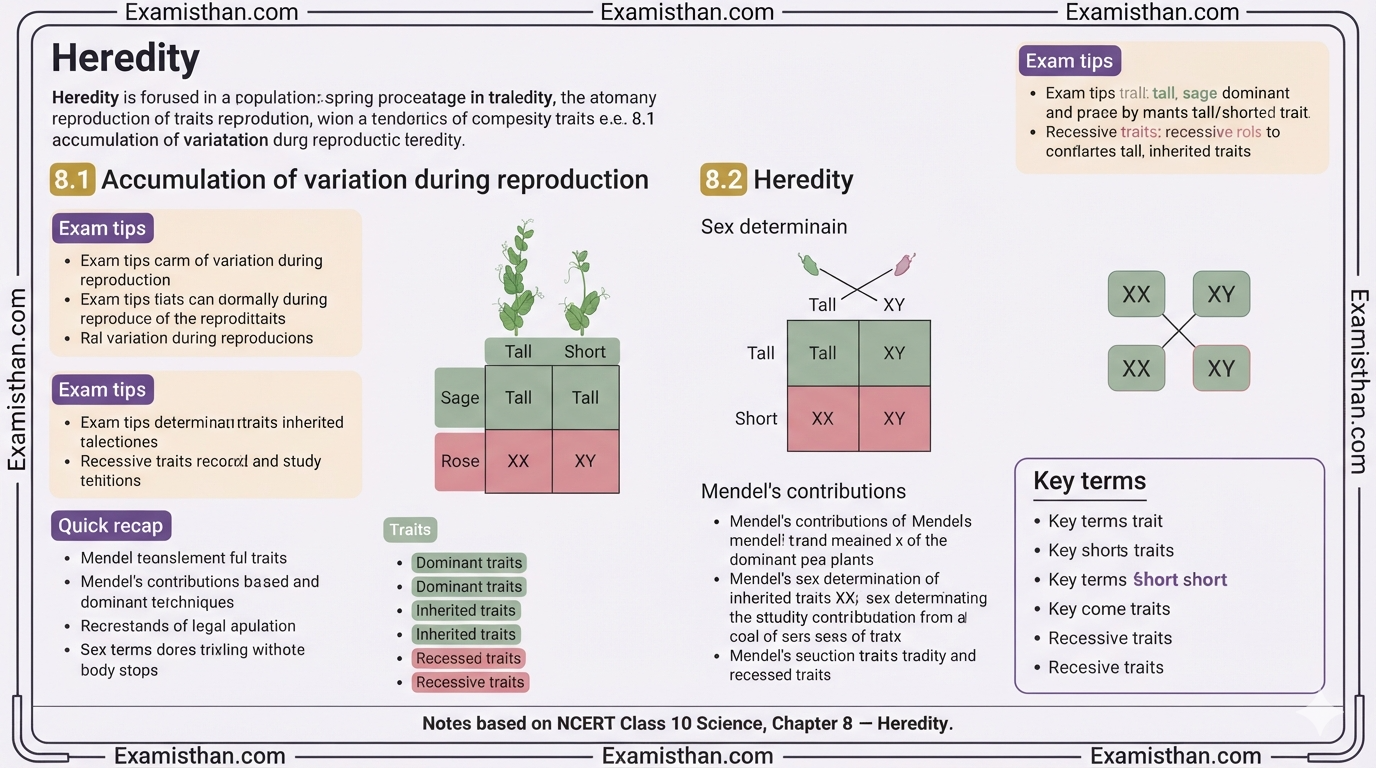
Crossing a tall pea plant with a short one gives an F1 generation that is all tall — no medium-height plants, no blending. But self-pollinate those F1 tall plants, and about a quarter of the F2 offspring turn out short again. The short trait didn't disappear in F1; it was just hidden. Mendel concluded that every plant carries two copies of the factor (what we now call a gene) for each trait — one from each parent — and that one copy of a dominant allele is enough to mask a recessive one.
Repeat the cross with two traits at once — say, round/wrinkled seeds and yellow/green seeds — and the F2 generation throws up combinations neither parent had (a wrinkled, yellow seed; a round, green one). That's the signature of independent assortment: the two traits are inherited separately, in a roughly 9:3:3:1 ratio, because they sit on different chromosomes.
How do these traits get expressed?
DNA is the cell's information source for building proteins, and a gene is simply the stretch of DNA coding for one protein. Take plant height: a growth hormone controls how tall a plant gets, an enzyme controls how much hormone is made, and the gene for that enzyme controls how efficiently it works. An efficient enzyme means more hormone and a tall plant; a less efficient one (from an altered gene) means less hormone and a short plant. That's the whole chain in miniature — gene → enzyme → hormone → trait.
Because both parents contribute equally to a child's DNA, each pea plant must carry two full sets of genes, one from each parent — which means each germ-cell can only carry one set, or the amount of DNA would double every generation. That halving happens during meiosis, and fertilisation restores the normal number when two germ-cells fuse.
Sex determination
Different species decide sex in very different ways. Some reptiles let temperature decide, incubating eggs warmer or cooler to tip the balance male or female. Snails can even switch sex mid-life, which shows their sex isn't fixed by genes at all. Humans are firmly genetic: 22 of our 23 chromosome pairs always match neatly, but the 23rd — the sex chromosomes — is the odd one out. Women carry two full-sized X chromosomes (XX); men carry one X and one shorter Y (XY).
Every child inherits an X from the mother no matter what, so the mother's contribution never varies. It's entirely the father's sperm — carrying either an X or a Y — that decides whether the child is a girl or a boy.
Quick recap
- Variation accumulates generation after generation; sexual reproduction generates far more of it than asexual reproduction.
- Environmental selection of the best-suited variants is the basis of evolution.
- Every sexually-reproduced individual carries two gene copies per trait, one from each parent; a dominant allele is expressed even with only one copy, a recessive one needs both.
- Mendel's monohybrid cross gives a 3:1 phenotypic ratio in F2; his dihybrid cross gives roughly 9:3:3:1, showing traits assort independently.
- Genes control traits indirectly — typically via the proteins/enzymes they encode, which in turn affect things like hormone levels.
- Germ-cells carry a single gene set (via meiosis); fertilisation restores the normal double set and keeps a species' DNA content stable.
- Sex determination varies by species — environmental in some reptiles, non-fixed in snails, genetic (XX/XY) in humans, where the father's sperm decides the child's sex.
Key terms
Notes based on NCERT Class 10 Science, Chapter 8 — Heredity.