Control and Coordination — Notes
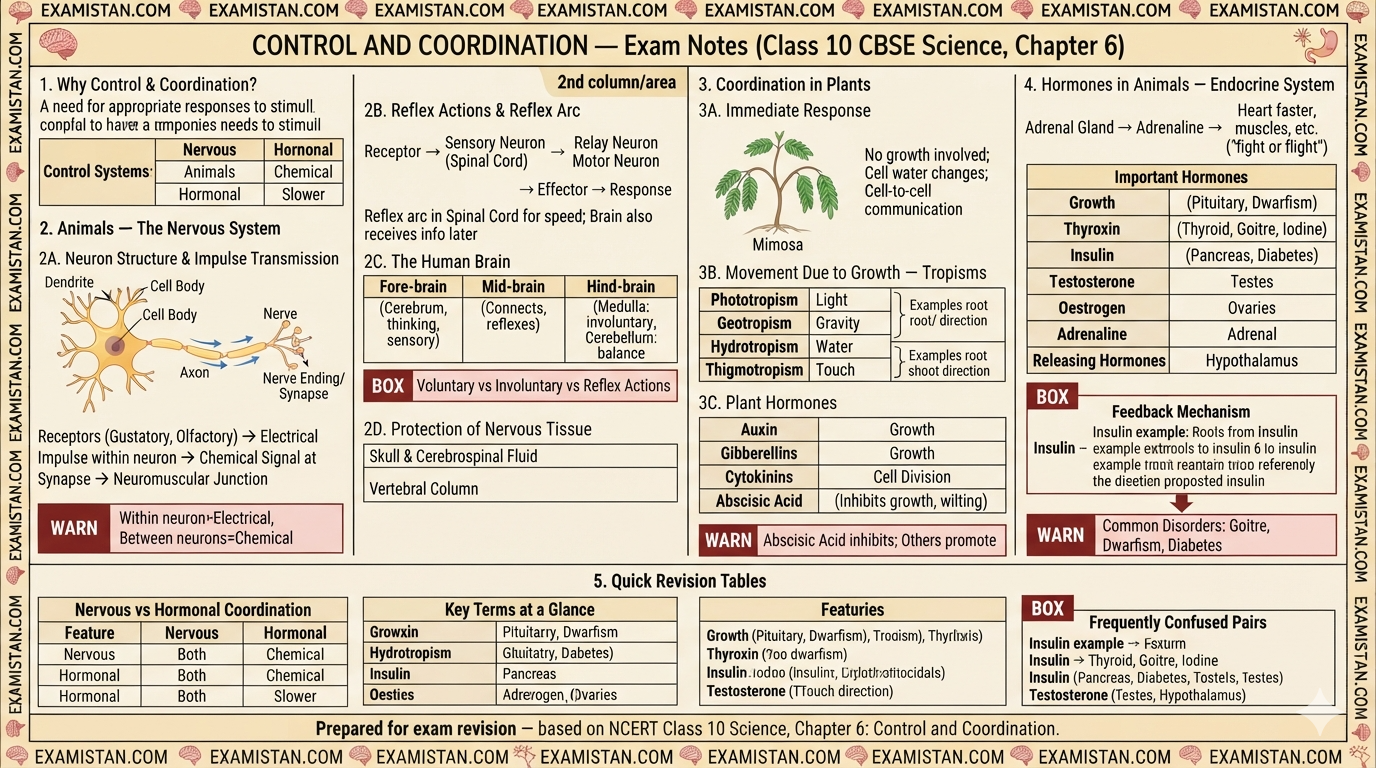
Control and Coordination
Class 10 · CBSE Science · Chapter 6 — Exam Preparation Notes
Contents
1. Why Control & Coordination Is Needed
All movement in response to the environment is carefully controlled. Each type of environmental change evokes an appropriate response (e.g. we whisper, not shout, in class). This means:
- The organism must first recognise the event/change in its environment.
- It must then produce only the correct movement/response.
- Living organisms therefore need systems for control and coordination.
Two systems of control & coordination
| System | Found in | Signal type | Speed |
|---|---|---|---|
| Nervous system | Animals only | Electrical impulses (via neurons) | Fast |
| Hormonal (endocrine) system | Both plants & animals | Chemical signals (hormones) | Slower but widespread & long-lasting |
2. Animals — The Nervous System
In animals, control & coordination is provided by nervous tissue and muscular tissue.
2A. Neuron Structure & Impulse Transmission
- Receptors — specialised nerve cell tips that detect information from the environment; found mainly in sense organs.
- Gustatory receptors → detect taste (tongue); Olfactory receptors → detect smell (nose).
- Information is acquired at the dendritic tip → triggers a chemical reaction → creates an electrical impulse.
- Impulse travels: dendrite → cell body → along axon to its end.
- At the axon's end, the impulse triggers release of chemicals that cross the synapse (gap between neurons) → starts a new electrical impulse in the next neuron's dendrite.
- Neuromuscular junction — synapse-like junction where a neuron finally delivers an impulse to a muscle (or gland) cell.
Exam tip
Within one neuron → signal is electrical. Between two neurons (at the synapse) → signal is chemical. This distinction is a very common exam question.
2B. Reflex Actions & Reflex Arc
Reflex action = a rapid, automatic response to a stimulus, made without conscious thought (e.g. pulling hand back from a flame).
- The pathway above is called the reflex arc.
- Reflex arcs form in the spinal cord itself (not the brain) — this makes the response very fast, since thinking via the brain would take too long and risk injury.
- Sensory information ALSO continues on to the brain — so we become consciously aware of what happened, just slightly later.
- Reflex arcs evolved because the brain's thinking process is too slow for urgent/dangerous situations; many simple animals rely entirely on reflex arcs (little/no complex brain).
2C. The Human Brain
Brain + Spinal cord = Central Nervous System (CNS) — receives information from all over the body and integrates it.
Peripheral Nervous System (PNS) = cranial nerves (from brain) + spinal nerves (from spinal cord) — connects CNS to rest of body.
| Region | Sub-part | Function |
|---|---|---|
| Fore-brain | Cerebrum + association areas | Main thinking region; receives sensory impulses (hearing, smell, sight); interprets sensory info; hunger centre; sends decisions to motor areas (controls voluntary muscles) |
| Hind-brain | Medulla | Controls involuntary actions: blood pressure, salivation, vomiting |
| Cerebellum | Precision of voluntary actions; maintains posture & balance (e.g. walking straight, riding a bicycle) | |
| Mid-brain | — | Connects fore-brain and hind-brain; relay/reflex centre (e.g. certain visual/auditory reflexes) |
Voluntary vs Involuntary vs Reflex actions
| Type | Control | Example |
|---|---|---|
| Voluntary action | Conscious decision (fore-brain) | Writing, talking, clapping, moving a chair |
| Involuntary action | No conscious control (mid-brain, hind-brain — mainly medulla) | Heartbeat, salivation, blood pressure, vomiting |
| Reflex action | Spinal cord (reflex arc) — fastest | Withdrawing hand from flame, change in pupil size |
2D. Protection of Nervous Tissue
- Brain — protected by the skull (bony box); inside, cushioned by a fluid-filled balloon (cerebrospinal fluid) for shock absorption.
- Spinal cord — protected by the vertebral column (backbone).
2E. How Nervous Tissue Causes Action
- Nervous tissue collects, transmits, and processes information, and conveys decisions — but muscle tissue performs the final movement.
- Muscle cells contain special proteins that change shape & rearrange in response to a nerve impulse → the muscle cell shortens (contracts).
3. Coordination in Plants
Plants have neither a nervous system nor muscles, yet they respond to stimuli using electrical-chemical signals (cell to cell, no specialised conducting tissue) and hormones.
3A. Immediate Response (No Growth)
Example: Sensitive plant (chhui-mui / touch-me-not, Mimosa)
- Touching the leaves → they fold up & droop quickly.
- No growth is involved — this is a rapid, reversible movement.
- Movement usually occurs at a point different from the point of touch → shows that information is communicated cell-to-cell.
- Mechanism: plant cells change shape by changing the amount of water in them (swelling/shrinking) — not via special contractile proteins (unlike animal muscle cells).
3B. Movement Due to Growth — Tropisms
Tropic (tropism) movements = directional growth movements in response to a stimulus; can be towards (positive) or away from (negative) the stimulus.
| Tropism | Stimulus | Typical response |
|---|---|---|
| Phototropism | Light | Shoot → bends towards light (positive); Root → bends away (negative) |
| Geotropism | Gravity | Root → grows downward (positive); Shoot → grows upward (negative) |
| Hydrotropism | Water | Roots grow towards moisture |
| Chemotropism | Chemicals | Growth of pollen tube towards ovule |
| Thigmotropism (touch-related growth) | Touch/contact with a support | Tendrils of pea plant coil around a support (the touching side grows slower than the far side, causing coiling) |
Activity 5.8 / 6.2 — Demonstrating Phototropism
Bean seedlings on a flask kept in a box open to light from one side → after 2–3 days, shoots bend towards light, roots bend away from light.
3C. Plant Hormones
| Hormone | Site of synthesis | Main function |
|---|---|---|
| Auxin | Shoot tip | Promotes cell elongation; diffuses to shady side of shoot → that side grows longer → shoot bends towards light (phototropism) |
| Gibberellins | — | Helps in growth of the stem (like auxins) |
| Cytokinins | Areas of rapid cell division (fruits, seeds) | Promotes cell division |
| Abscisic acid | — | Inhibits growth (growth-inhibiting hormone); causes wilting of leaves |
Exam tip
Only Abscisic acid among the above INHIBITS growth — the other three (auxin, gibberellin, cytokinin) all PROMOTE growth/cell division. A favourite MCQ trap!
4. Hormones in Animals — Endocrine System
Chemical (hormonal) coordination reaches all cells of the body via the bloodstream — slower than nerve impulses but longer-lasting and more widespread. This is the endocrine system.
Example — Adrenaline ("fight or flight" hormone)
- Secreted by: Adrenal glands, directly into the blood.
- Effects: heart beats faster (more O₂ to muscles); blood diverted away from digestive system & skin towards skeletal muscles; breathing rate increases (diaphragm + rib muscle contractions).
- Purpose: prepares the body quickly for either fighting or running away.
| Hormone | Endocrine Gland | Function |
|---|---|---|
| Growth hormone | Pituitary gland | Stimulates growth in all organs; deficiency in childhood → dwarfism |
| Thyroxin | Thyroid gland | Regulates carbohydrate, protein & fat metabolism for body growth; needs iodine; deficiency → goitre (swollen neck) |
| Insulin | Pancreas | Regulates blood sugar level; deficiency → diabetes (treated with insulin injections) |
| Testosterone | Testes | Puberty changes in males |
| Oestrogen | Ovaries | Development of female sex organs; regulates menstrual cycle |
| Adrenaline | Adrenal gland | "Fight or flight" response |
| Releasing hormones | Hypothalamus | Stimulate the pituitary gland to release its hormones (e.g. growth hormone releasing factor) |
Feedback Mechanism
Timing & amount of hormone secretion are regulated by feedback. Example: rise in blood sugar → pancreas cells detect it → produce more insulin → blood sugar falls → insulin secretion is reduced. This keeps hormone levels precisely balanced.
Common disorders — quick recall
| Disorder | Cause |
|---|---|
| Goitre | Iodine deficiency → low thyroxin |
| Dwarfism | Growth hormone deficiency (childhood) |
| Diabetes | Insufficient/improper insulin secretion |
5. Quick Revision Tables
| Feature | Nervous system | Hormonal (endocrine) system |
|---|---|---|
| Signal | Electrical impulse (within neuron) + chemical (at synapse) | Chemical (hormone) via blood/diffusion |
| Speed | Fast | Slower |
| Reach | Only cells connected by nerves | All cells of the body |
| Duration of effect | Short-lived | Longer-lasting |
| Found in | Animals only | Both plants & animals |
| Term | Meaning |
|---|---|
| Receptor | Specialised nerve cell tip that detects a stimulus |
| Synapse | Gap between two neurons; chemical signal crosses here |
| Neuromuscular junction | Point where a neuron passes an impulse to a muscle cell |
| Reflex arc | Fast pathway: receptor → sensory neuron → relay neuron (spinal cord) → motor neuron → effector |
| Effector | Muscle/gland that carries out the response |
| Tropism | Directional growth movement of a plant in response to a stimulus |
| Hormone | Chemical messenger, synthesised at one site, acting at another (in plants & animals) |
Frequently confused pairs — quick check
- Reflex action vs Voluntary action — reflex = spinal cord, automatic, fast; voluntary = brain (fore-brain), conscious, decided.
- Medulla vs Cerebellum — medulla = involuntary actions (BP, salivation, vomiting); cerebellum = posture, balance, precision of voluntary movement.
- Phototropism vs Geotropism — phototropism responds to light (shoot towards, root away); geotropism responds to gravity (root towards/down, shoot away/up).
- Auxin vs Abscisic acid — auxin promotes growth (cell elongation); abscisic acid inhibits growth (wilting).
- Insulin vs Adrenaline — insulin regulates blood sugar (normal metabolism, pancreas); adrenaline prepares body for emergency ("fight or flight", adrenal gland).