Carbon and its Compounds — Notes
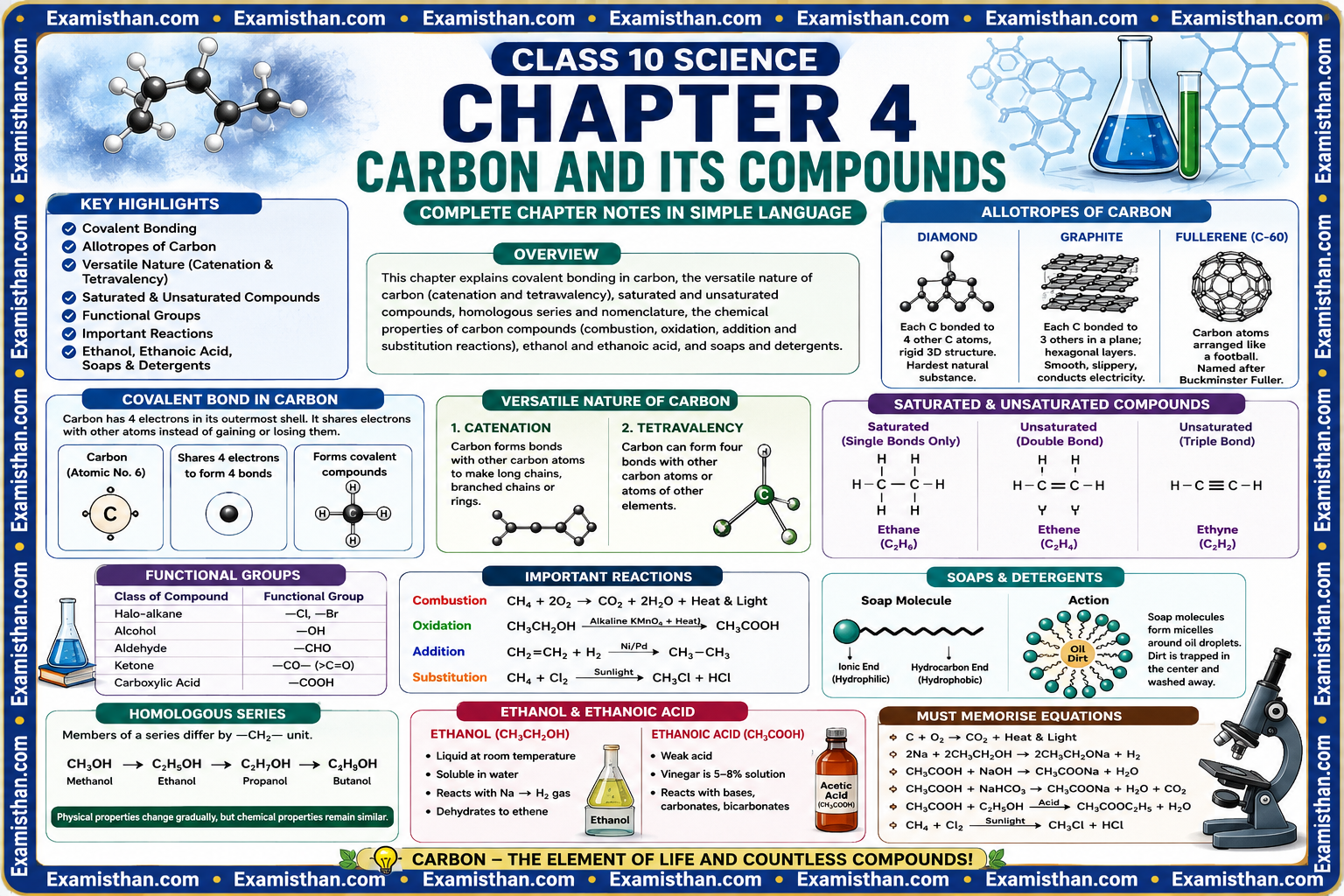
Carbon and its Compounds
Complete Chapter Notes in Simple Language
📚 Chapter Contents
- Bonding in Carbon — The Covalent Bond
- Bonding in Simple Molecules
- Allotropes of Carbon
- Versatile Nature of Carbon
- Saturated and Unsaturated Compounds
- Chains, Branches and Rings
- Functional Groups
- Homologous Series
- Nomenclature of Carbon Compounds
- Combustion
- Oxidation
- Addition Reaction
- Substitution Reaction
- Ethanol
- Ethanoic Acid
- Esterification & Saponification
- Soaps and Detergents
- 20 Important Questions
1 Bonding in Carbon — The Covalent Bond
Most carbon compounds are poor conductors of electricity and have low melting and boiling points compared to ionic compounds. This tells us that the forces between their molecules are weak and that their bonding does not produce any ions.
| Compound | Melting Point (K) | Boiling Point (K) |
|---|---|---|
| Acetic acid (CH3COOH) | 290 | 391 |
| Chloroform (CHCl3) | 209 | 334 |
| Ethanol (CH3CH2OH) | 156 | 351 |
| Methane (CH4) | 90 | 111 |
Why Carbon Doesn't Form Ions
Carbon has 4 electrons in its outermost shell (atomic number 6) and needs to gain or lose 4 electrons for a noble gas configuration.
- Gaining 4 electrons (C4−): difficult, since a nucleus with only 6 protons would struggle to hold 10 electrons.
- Losing 4 electrons (C4+): would need a huge amount of energy.
2 Bonding in Simple Molecules
| Molecule | Shared Pairs | Bond Type |
|---|---|---|
| H2 | 1 | Single bond |
| Cl2 | 1 | Single bond |
| O2 | 2 | Double bond |
| N2 | 3 | Triple bond |
| CH4 | 4 (one per C–H bond) | Four single bonds |
3 Allotropes of Carbon
| Allotrope | Structure | Property |
|---|---|---|
| Diamond | Each C bonded to 4 other C atoms, rigid 3D structure | Hardest natural substance known |
| Graphite | Each C bonded to 3 others in a plane; hexagonal layers | Smooth, slippery, conducts electricity |
| Fullerene (C-60) | Carbon atoms arranged like a football | Named after architect Buckminster Fuller |
4 Versatile Nature of Carbon
Millions of carbon compounds are known — far more than all other elements combined. Two properties explain this:
1. Catenation
Carbon's unique ability to form bonds with other carbon atoms, creating long chains, branched chains or rings. No other element shows catenation to this extent — silicon forms chains of only 7-8 atoms, and these are very reactive, unlike carbon's strong, stable C–C bonds.
2. Tetravalency
Carbon has a valency of four, so it can bond with four other carbon atoms or atoms of other monovalent elements (hydrogen, oxygen, nitrogen, sulphur, chlorine, etc.), forming compounds with a huge range of specific properties.
5 Saturated and Unsaturated Compounds
| Compound | Formula | Type |
|---|---|---|
| Ethane | C2H6 | Saturated (single bond) |
| Ethene | C2H4 | Unsaturated (double bond) |
| Ethyne | C2H2 | Unsaturated (triple bond) |
6 Chains, Branches and Rings
| No. of C atoms | Name | Formula |
|---|---|---|
| 1 | Methane | CH4 |
| 2 | Ethane | C2H6 |
| 3 | Propane | C3H8 |
| 4 | Butane | C4H10 |
| 5 | Pentane | C5H12 |
| 6 | Hexane | C6H14 |
Structural Isomers
Butane (C4H10) can exist as two different structures — a straight chain, or a branched chain — with the same molecular formula. Such compounds are called structural isomers.
Rings and Hydrocarbon Classification
Carbon atoms can also form rings, as in cyclohexane (C6H12) and benzene (C6H6). Compounds containing only carbon and hydrogen are called hydrocarbons:
Alkenes — one or more double bonds (CnH2n)
Alkynes — one or more triple bonds (CnH2n−2)
7 Functional Groups
A heteroatom (or group) that replaces a hydrogen in a hydrocarbon chain, and which gives the compound its characteristic properties, is called a functional group.
| Hetero atom | Class of compound | Functional group |
|---|---|---|
| Cl/Br | Halo-alkane | —Cl, —Br |
| Oxygen | Alcohol | —OH |
| Oxygen | Aldehyde | —CHO |
| Oxygen | Ketone | —CO— (>C=O) |
| Oxygen | Carboxylic acid | —COOH |
8 Homologous Series
A series of compounds in which the same functional group substitutes for hydrogen in a carbon chain of varying length is called a homologous series — for example, methanol, ethanol, propanol and butanol.
9 Nomenclature of Carbon Compounds
| Class | Prefix/Suffix | Example (3-C chain) |
|---|---|---|
| Halo alkane | Prefix: chloro-, bromo- | Chloropropane |
| Alcohol | Suffix: -ol | Propanol |
| Aldehyde | Suffix: -al | Propanal |
| Ketone | Suffix: -one | Propanone |
| Carboxylic acid | Suffix: -oic acid | Propanoic acid |
| Alkene | Suffix: -ene | Propene |
| Alkyne | Suffix: -yne | Propyne |
10 Combustion
CH4 + 2O2 → CO2 + 2H2O + heat and light
- Saturated hydrocarbons generally burn with a clean flame.
- Unsaturated compounds burn with a yellow, sooty flame with lots of black smoke.
- Limiting the air supply causes incomplete combustion and a sooty flame, even for saturated hydrocarbons — seen as blackened cooking vessels when a stove's air holes are blocked.
- Coal and petroleum contain nitrogen and sulphur, whose combustion forms polluting oxides.
11 Oxidation
Substances capable of adding oxygen to others are called oxidising agents. Alkaline potassium permanganate or acidified potassium dichromate oxidise alcohols to carboxylic acids.
12 Addition Reaction
Unsaturated hydrocarbons add hydrogen in the presence of a catalyst (palladium or nickel) to give saturated hydrocarbons. A catalyst speeds up a reaction without being permanently changed itself.
13 Substitution Reaction
Saturated hydrocarbons are fairly unreactive. But in sunlight, chlorine replaces hydrogen atoms one by one in a fast reaction — this is called a substitution reaction.
14 Ethanol
Ethanol (commonly called alcohol) is a liquid at room temperature, soluble in water in all proportions, and used as a solvent in medicines like tincture iodine and cough syrups. Pure ethanol (absolute alcohol) is called and even a small quantity can be lethal.
Reactions of Ethanol
CH3CH2OH →(Hot conc. H2SO4, 443 K)→ CH2=CH2 + H2O
Reaction with sodium evolves hydrogen gas and forms sodium ethoxide. Heating with excess concentrated sulphuric acid dehydrates ethanol to ethene (sulphuric acid acts as a dehydrating agent).
15 Ethanoic Acid
Ethanoic acid (acetic acid) belongs to the carboxylic acid group. A 5-8% solution in water is called vinegar. Pure ethanoic acid freezes at 290 K in cold climates, giving it the name glacial acetic acid. Unlike mineral acids like HCl, carboxylic acids are weak acids — not completely ionised.
Reactions of Ethanoic Acid
2CH3COOH + Na2CO3 → 2CH3COONa + H2O + CO2
CH3COOH + NaHCO3 → CH3COONa + H2O + CO2
Reaction with a base gives sodium ethanoate (sodium acetate) and water. Reaction with carbonates/hydrogencarbonates gives a salt, water and carbon dioxide (confirmed by turning lime water milky).
16 Esterification & Saponification
Esterification
An acid catalyst helps ethanoic acid react with ethanol to form a sweet-smelling ester and water — this is used in perfumes and flavouring agents.
Saponification
Treating an ester with sodium hydroxide converts it back to alcohol and the sodium salt of the carboxylic acid — this reaction is called saponification, because it is used to prepare soap.
17 Soaps and Detergents
A soap molecule has two ends with different properties:
- Ionic end — hydrophilic, interacts with water.
- Hydrocarbon (carbon-chain) end — hydrophobic, interacts with oil/grease.
The micelle traps dirt in its centre and stays suspended in water (as a colloid), allowing it to be rinsed away. Soap micelles are large enough to scatter light, which is why a soap solution looks cloudy.
18 20 Important Questions for Exam Preparation
- What is a covalent bond? Explain with the example of a hydrogen molecule.
- Why does carbon form covalent compounds instead of ionic ones?
- What are allotropes? Compare the structures of diamond and graphite.
- What are the two properties of carbon that lead to the huge number of carbon compounds?
- What is catenation? Why doesn't silicon show it to the same extent as carbon?
- Differentiate between saturated and unsaturated carbon compounds, with examples.
- What are structural isomers? Illustrate with butane.
- What is a functional group? List any three functional groups with their formulae.
- What is a homologous series? Explain with an example.
- Name the compounds represented by (i) a 3-carbon chain with a double bond (ii) a 3-carbon chain with the -OH group.
- Write balanced equations for the combustion of methane and ethanol.
- What are oxidising agents? Give an example of an oxidation reaction of ethanol.
- What is hydrogenation? What is its industrial application?
- Give a test to differentiate between saturated and unsaturated hydrocarbons.
- What is a substitution reaction? Give an example involving methane.
- How would you distinguish experimentally between an alcohol and a carboxylic acid?
- What is esterification? What is saponification?
- Explain the mechanism of the cleaning action of soaps.
- Why do soaps not work well in hard water, but detergents do?
- Explain why carbon and its compounds are used as fuels for most applications.
✓ Final Quick Revision
Formed by sharing an electron pair; carbon needs 4 electrons, so it shares rather than forms ions.
Diamond (4 bonds, hardest substance), Graphite (3 bonds, conducts electricity), Fullerene (football-shaped, C-60).
Catenation + Tetravalency → millions of carbon compounds.
Alkanes: CnH2n+2 | Alkenes: CnH2n | Alkynes: CnH2n−2
Alcohol —OH | Aldehyde —CHO | Ketone —CO— | Carboxylic acid —COOH
Combustion (fuel burning), Oxidation (alcohol → acid), Addition (hydrogenation), Substitution (with Cl2 in sunlight).
Ethanol: alcohol, soluble in water, reacts with Na → H2. Ethanoic acid: weak acid, reacts with base/carbonate.
Ionic end (hydrophilic) + hydrocarbon end (hydrophobic) → micelles trap dirt; detergents work even in hard water.
Must-Memorise Chemical Equations
C + O2 → CO2 + heat and light
CH3CH2OH →(Alkaline KMnO4)→ CH3COOH
2Na + 2CH3CH2OH → 2CH3CH2ONa + H2
CH3CH2OH →(Hot conc. H2SO4)→ CH2=CH2 + H2O
NaOH + CH3COOH → CH3COONa + H2O
CH3COOH + NaHCO3 → CH3COONa + H2O + CO2
CH3COOH + CH3CH2OH →(Acid)→ Ester + H2O
CH4 + Cl2 →(sunlight)→ CH3Cl + HCl
Class 10 Science — Chapter 4
Carbon and its Compounds
Complete Revision Notes