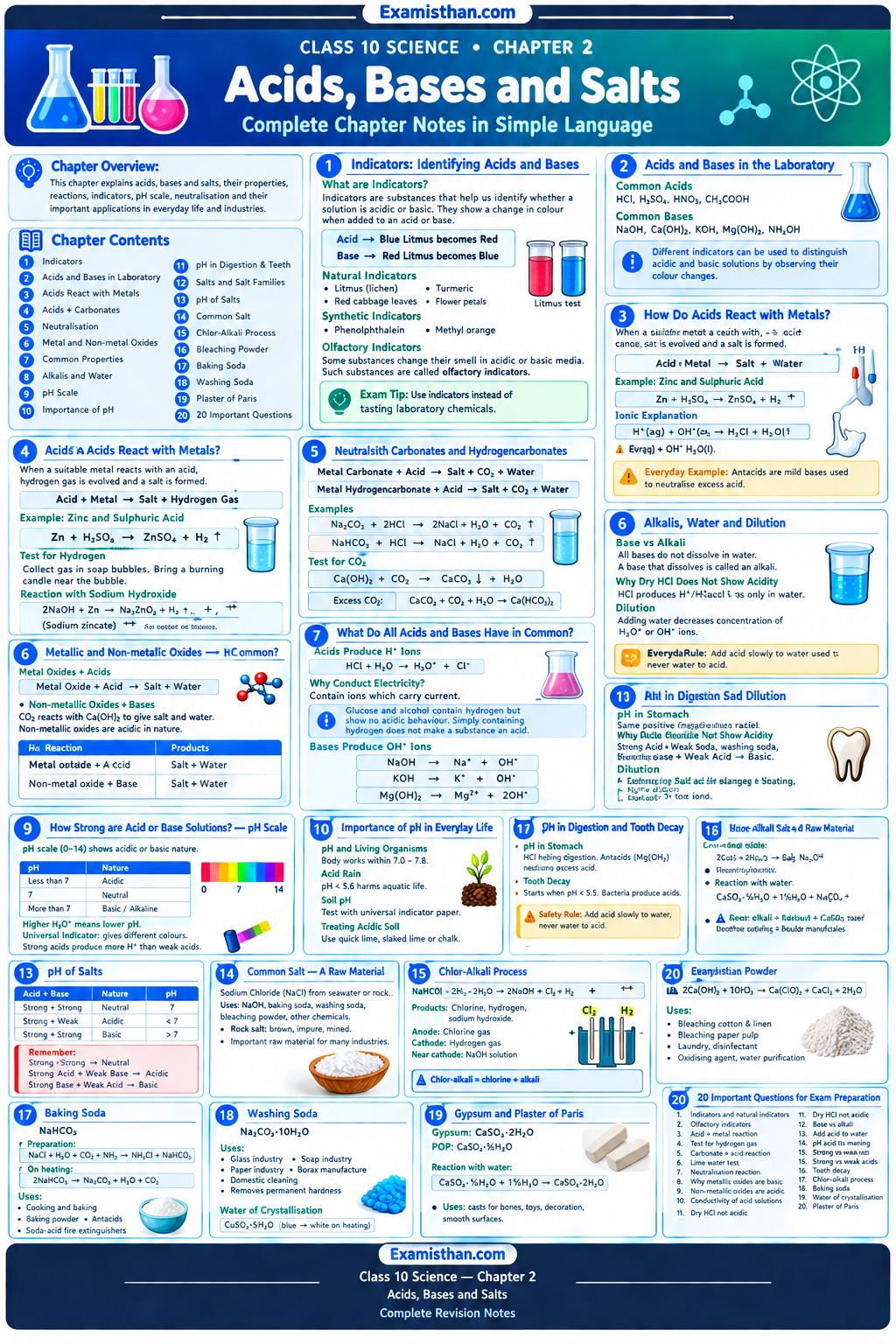
Acids, Bases and Salts — Notes
Acids, Bases and Salts
Complete Chapter Notes in Simple Language
📚 Chapter Contents
- Indicators
- Acids and Bases in Laboratory
- Acids React with Metals
- Acids + Carbonates
- Neutralisation
- Metal and Non-metal Oxides
- Common Properties
- Alkalis and Water
- pH Scale
- Importance of pH
- pH in Digestion & Teeth
- Salts and Salt Families
- pH of Salts
- Common Salt
- Chlor-Alkali Process
- Bleaching Powder
- Baking Soda
- Washing Soda
- Plaster of Paris
- 20 Important Questions
1 Indicators: Identifying Acids and Bases
What are Indicators?
Indicators are substances that help us identify whether a solution is acidic or basic. They generally show a change in colour when added to an acidic or basic solution.
Base → Red Litmus becomes Blue
Natural Indicators
- Litmus — a natural dye obtained from lichen.
- Turmeric — a natural indicator.
- Red cabbage leaves can indicate acidic or basic nature.
- Some coloured flower petals can also act as indicators.
Synthetic Indicators
- Phenolphthalein
- Methyl orange
Olfactory Indicators
Some substances change their smell in acidic or basic media. Such substances are called olfactory indicators.
2 Acids and Bases in the Laboratory
Common Acids
Hydrochloric acid (HCl), sulphuric acid (H2SO4), nitric acid (HNO3) and acetic acid (CH3COOH).
Common Bases
Sodium hydroxide (NaOH), calcium hydroxide [Ca(OH)2], potassium hydroxide (KOH), magnesium hydroxide [Mg(OH)2] and ammonium hydroxide (NH4OH).
3 How Do Acids React with Metals?
When a suitable metal reacts with an acid, hydrogen gas is evolved and a salt is formed.
Example: Zinc and Sulphuric Acid
Test for Hydrogen
The gas evolved can be collected in soap bubbles. A burning candle is brought near the gas-filled bubble to test the gas.
Reaction of Zinc with Sodium Hydroxide
The salt formed here is sodium zincate.
4 Acids with Metal Carbonates and Hydrogencarbonates
Sodium Carbonate + Hydrochloric Acid
Sodium Hydrogencarbonate + Hydrochloric Acid
Test for Carbon Dioxide
Carbon dioxide is passed through lime water. It turns milky because calcium carbonate is formed.
On passing excess carbon dioxide, soluble calcium hydrogencarbonate is formed.
5 Neutralisation Reaction
When an acid reacts with a base and their effects are cancelled, salt and water are formed. This is called a neutralisation reaction.
Ionic Explanation
6 Metallic and Non-metallic Oxides
Metal Oxides + Acids
Metallic oxides are therefore described as basic oxides.
Non-metallic Oxides + Bases
Carbon dioxide reacts with calcium hydroxide to produce salt and water. Therefore, non-metallic oxides are considered acidic in nature.
| Reaction | Products |
|---|---|
| Metal oxide + Acid | Salt + Water |
| Non-metal oxide + Base | Salt + Water |
7 What Do All Acids and Bases Have in Common?
Acids Produce H+ Ions in Water
Acids show their acidic properties because they produce hydrogen ions in aqueous solution.
Hydrogen ions do not exist alone in water. They combine with water molecules and form hydronium ions (H3O+).
Why Acid Solutions Conduct Electricity
Acid solutions contain ions. These ions carry electric current through the solution.
Bases Produce OH− Ions
8 Alkalis, Water and Dilution
Base vs Alkali
All bases do not dissolve in water. A base that dissolves in water is called an alkali.
Why Dry HCl Does Not Show Acidity
HCl produces hydrogen/hydronium ions in the presence of water. Therefore, dry HCl gas does not change the colour of dry litmus.
Dilution
When an acid or base is mixed with water, the concentration of H3O+ or OH− ions per unit volume decreases. This process is called dilution.
9 How Strong are Acid or Base Solutions? — pH Scale
The pH scale is used to express the acidic or basic nature of a solution. The chapter describes a general scale from 0 to 14.
| pH | Nature |
|---|---|
| Less than 7 | Acidic |
| 7 | Neutral |
| More than 7 | Basic / Alkaline |
Hydrogen Ion Concentration
Higher hydronium ion concentration means a lower pH value.
Universal Indicator
A universal indicator is a mixture of several indicators. It gives different colours for different hydrogen-ion concentrations.
Strong and Weak Acids
For the same concentration, acids that produce more H+ ions are called strong acids, while acids producing fewer H+ ions are called weak acids.
10 Importance of pH in Everyday Life
pH and Living Organisms
The chapter states that our body works within a pH range of about 7.0 to 7.8. Living organisms can survive only within a relatively narrow pH range.
Acid Rain
Rain water having a pH below 5.6 is called acid rain. It can lower the pH of river water and make survival of aquatic organisms difficult.
pH of Soil
Plants require a suitable soil pH for healthy growth. Soil pH can be checked by preparing a water extract of the soil and testing it with universal indicator paper.
Treating Acidic Soil
Basic materials such as quick lime, slaked lime and chalk can be used to neutralise excessive acidity in soil.
11 pH in Digestion and Tooth Decay
pH in the Stomach
The stomach produces hydrochloric acid, which helps in digestion. Too much acid can cause pain and irritation.
Antacids are mild bases that neutralise excess stomach acid. Magnesium hydroxide (milk of magnesia) is one example mentioned in the chapter.
Tooth Decay
Tooth decay starts when the pH of the mouth falls below about 5.5.
Bacteria in the mouth produce acids by breaking down sugar and food particles remaining after eating.
Bee Sting and Nettle Sting
Bee sting leaves an acid that causes pain and irritation. A mild base such as baking soda can provide relief.
Nettle leaves inject methanoic acid, causing burning pain.
12 More About Salts
Family of Salts
Salts having the same positive or negative radical are said to belong to the same family.
| Family | Examples |
|---|---|
| Sodium salts | NaCl, Na2SO4 |
| Chloride salts | NaCl, KCl |
Naturally Occurring Acids
| Natural Source | Acid |
|---|---|
| Vinegar | Acetic acid |
| Sour milk / Curd | Lactic acid |
| Orange | Citric acid |
| Lemon | Citric acid |
| Tamarind | Tartaric acid |
| Tomato | Oxalic acid |
| Ant sting | Methanoic acid |
| Nettle sting | Methanoic acid |
13 pH of Salts
| Acid + Base | Nature of Salt | pH |
|---|---|---|
| Strong acid + Strong base | Neutral | 7 |
| Strong acid + Weak base | Acidic | Less than 7 |
| Strong base + Weak acid | Basic | More than 7 |
Strong + Strong → Neutral
Strong Acid + Weak Base → Acidic
Strong Base + Weak Acid → Basic
14 Common Salt — A Raw Material
Sodium Chloride
Sodium chloride (NaCl) is the common salt used in food. It can be obtained from seawater. It is also found naturally as rock salt.
Rock Salt
Rock salt contains impurities and often appears brown. It is found in large deposits and is mined like coal.
Uses as Raw Material
Common salt is an important raw material for manufacturing:
- Sodium hydroxide
- Baking soda
- Washing soda
- Bleaching powder
- Other useful chemicals
15 Chlor-Alkali Process
When electricity is passed through an aqueous solution of sodium chloride called brine, sodium hydroxide, chlorine and hydrogen are produced.
Products at Electrodes
- Anode: Chlorine gas
- Cathode: Hydrogen gas
- Near cathode: Sodium hydroxide solution
16 Bleaching Powder
Bleaching powder is produced by the action of chlorine on dry slaked lime, Ca(OH)2.
The chapter represents bleaching powder as Ca(ClO)2, while noting that its actual composition is complex.
Uses
- Bleaching cotton and linen.
- Bleaching wood pulp in paper factories.
- Bleaching washed clothes in laundries.
- Used as an oxidising agent.
- Used to make drinking water free from germs.
17 Baking Soda
What is Baking Soda?
Baking soda is sodium hydrogencarbonate: NaHCO3.
Preparation
Heating Baking Soda
Uses
- Used in cooking and baking.
- Used in baking powder.
- Used in antacids.
- Used in soda-acid fire extinguishers.
18 Washing Soda and Water of Crystallisation
Washing Soda
Washing soda is sodium carbonate decahydrate:
Sodium carbonate can be obtained by heating baking soda. Recrystallisation of sodium carbonate gives washing soda.
Uses of Washing Soda
- Glass industry
- Soap industry
- Paper industry
- Manufacture of sodium compounds such as borax
- Domestic cleaning
- Removing permanent hardness of water
Water of Crystallisation
Water of crystallisation is the fixed number of water molecules present in one formula unit of a salt.
On heating, copper sulphate crystals lose water of crystallisation and become white. Adding water restores the blue colour.
19 Gypsum and Plaster of Paris
Gypsum
Gypsum contains two molecules of water of crystallisation.
Plaster of Paris
When gypsum is heated at 373 K, it loses water and forms calcium sulphate hemihydrate, called Plaster of Paris.
Reaction with Water
POP changes back into gypsum and forms a hard solid mass when mixed with water.
Uses of Plaster of Paris
- Used as plaster for supporting fractured bones.
- Used for making toys.
- Used for decoration materials.
- Used for making surfaces smooth.
20 20 Important Questions for Exam Preparation
- What are acid-base indicators? Give two examples of natural indicators.
- What are olfactory indicators? Name the substances studied as olfactory indicators.
- What happens when an acid reacts with a metal? Give a balanced chemical equation.
- How can you test the gas evolved when zinc reacts with dilute sulphuric acid?
- Write the general reaction between a metal carbonate and an acid.
- Why does lime water turn milky when carbon dioxide is passed through it?
- What is a neutralisation reaction? Give one balanced equation.
- Why are metallic oxides called basic oxides?
- Why are non-metallic oxides considered acidic in nature?
- Why do aqueous solutions of acids conduct electricity?
- Why does dry HCl gas not change the colour of dry blue litmus paper?
- What is the difference between a base and an alkali?
- Why should concentrated acid be added to water and not water to acid?
- What is pH? What do pH values below 7, equal to 7 and above 7 indicate?
- What is the difference between strong and weak acids?
- Explain the importance of pH in tooth decay.
- What is the chlor-alkali process? Write its chemical equation.
- Write the preparation and important uses of baking soda.
- What is water of crystallisation? Explain using CuSO4·5H2O.
- What is Plaster of Paris? Write its preparation from gypsum and its reaction with water.
✓ Final Quick Revision
Litmus, turmeric, phenolphthalein, methyl orange and olfactory indicators help identify acidic/basic media.
Produce H+/H3O+ ions in aqueous solution.
Produce OH− ions in aqueous solution.
Acid + Base → Salt + Water.
Below 7 = acidic, 7 = neutral, above 7 = basic.
Important raw material for NaOH, baking soda, washing soda and bleaching powder.
NaHCO3
Na2CO3·10H2O
CaSO4·2H2O
CaSO4·½H2O
Must-Memorise Chemical Equations
Zn + H2SO4 → ZnSO4 + H2
NaHCO3 + HCl → NaCl + H2O + CO2
NaOH + HCl → NaCl + H2O
Ca(OH)2 + CO2 → CaCO3 + H2O
2NaCl + 2H2O → 2NaOH + Cl2 + H2
2NaHCO3 → Na2CO3 + H2O + CO2
CaSO4·½H2O + 1½H2O → CaSO4·2H2O
Class 10 Science — Chapter 2
Acids, Bases and Salts
Complete Revision Notes