Polynomials — Notes
📑 Chapter Navigator
01
2.1 Polynomial and Its Degree
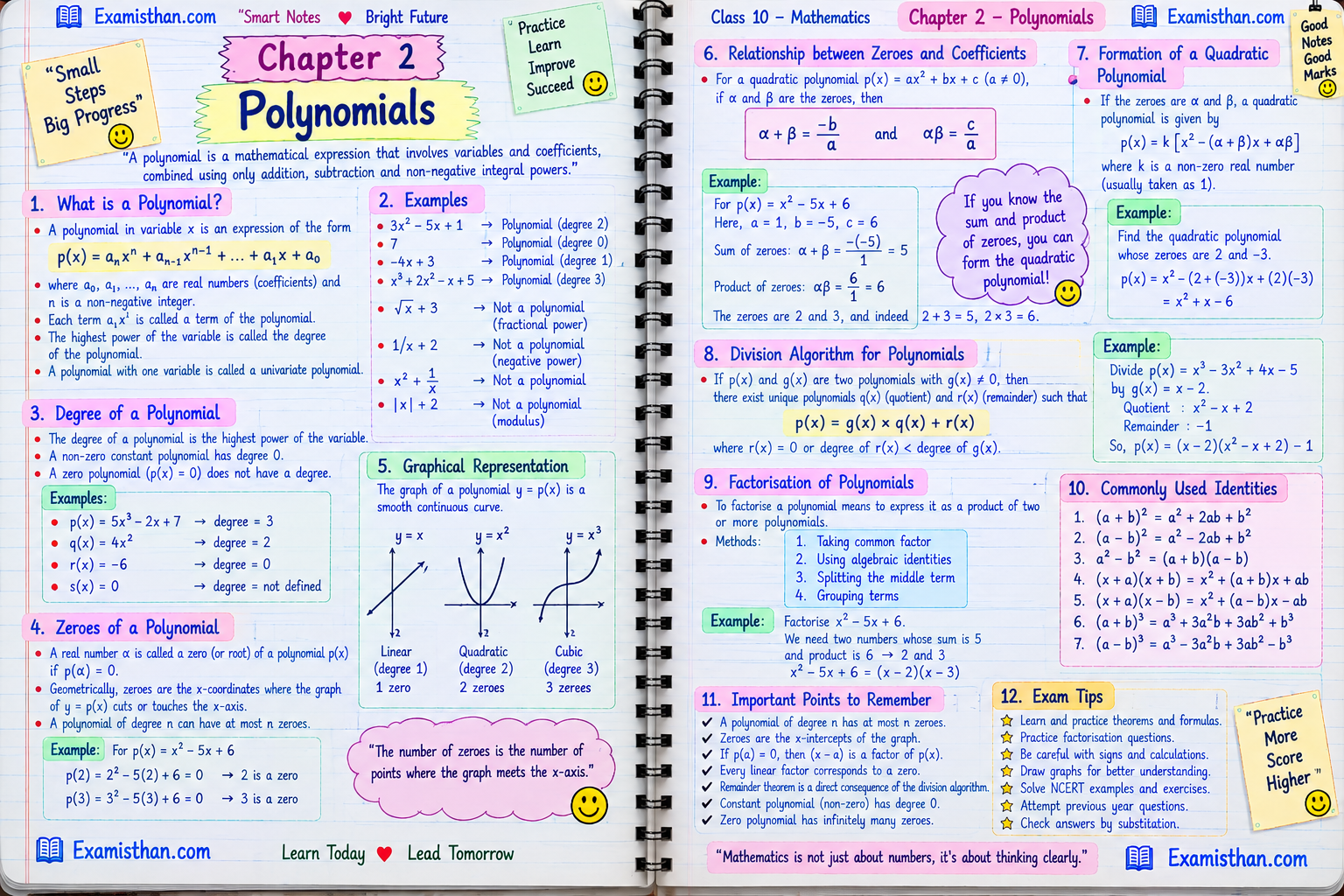
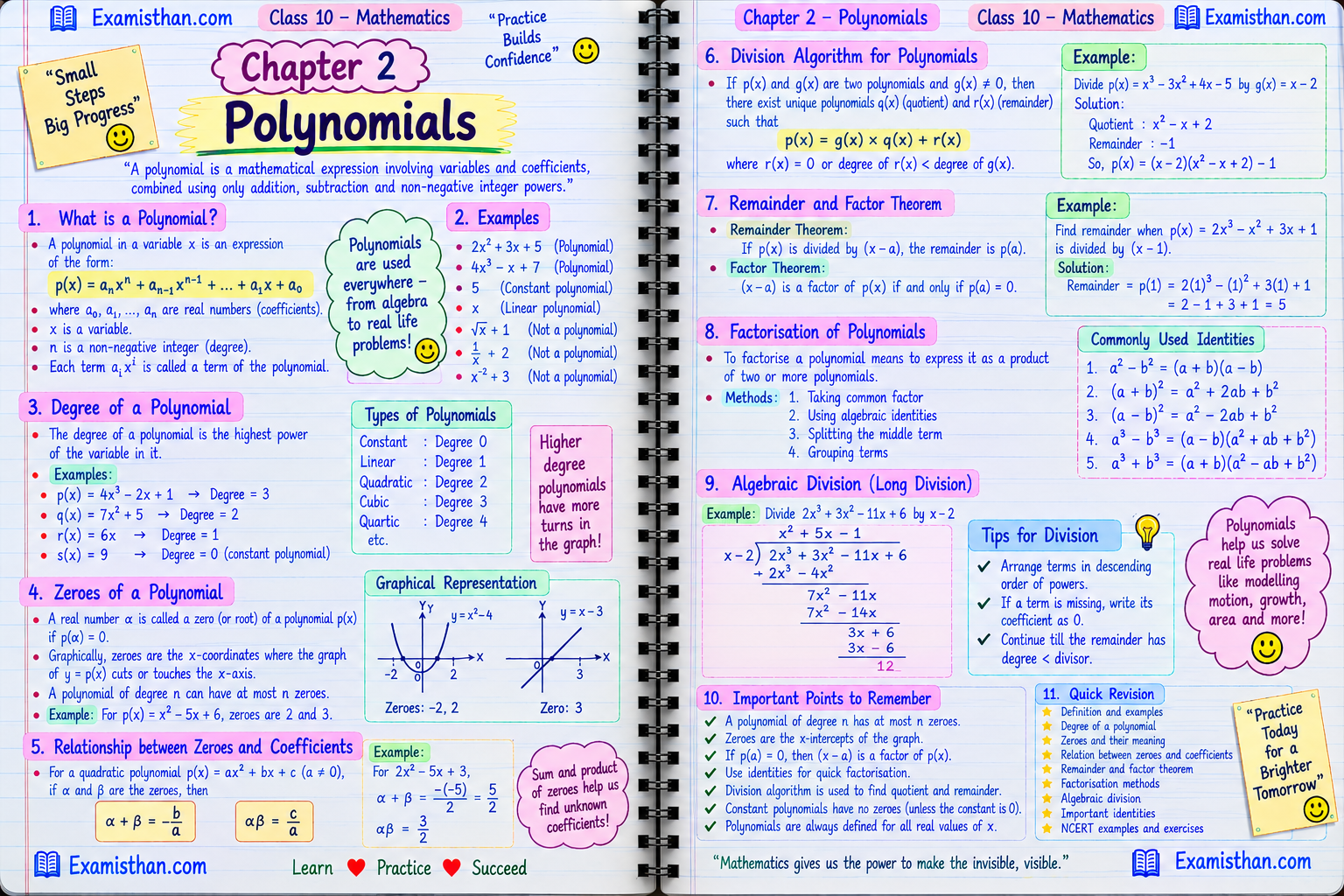
A polynomial in x has the form anxn + ... + a1x + a0, where coefficients are real numbers and an ≠ 0. The highest power of x with a non-zero coefficient is the degree.
02
2.2 Geometrical Meaning of Zeros
A zero of a polynomial p(x) is a value α for which p(α)=0. Geometrically, the real zeros are the x-coordinates where the graph of y = p(x) meets the x-axis.
Quadratic polynomial
For a quadratic polynomial, the graph may intersect the x-axis at two points, touch it at one point, or not meet it at all. Hence it can have two, one, or no real zeros.
03
2.3 Relationship between Zeros and Coefficients
For ax2 + bx + c with zeros α and β:
α + β = −b/a
αβ = c/a.
α + β = −b/a
αβ = c/a.
Cubic result
For ax3 + bx2 + cx + d with zeros α, β, γ:
α + β + γ = −b/a;
αβ + βγ + γα = c/a;
αβγ = −d/a.
α + β + γ = −b/a;
αβ + βγ + γα = c/a;
αβγ = −d/a.
04
2.4 Division Algorithm for Polynomials
If p(x) and g(x) are polynomials with g(x) ≠ 0, then there exist unique polynomials q(x) and r(x) such that p(x)=g(x)q(x)+r(x), where either r(x)=0 or degree r < degree g.
Remainder theorem
When a polynomial p(x) is divided by x−a, the remainder is p(a).
⚡ Quick Revision
- Zero α means p(α)=0.
- Quadratic sum of zeros = −b/a.
- Quadratic product of zeros = c/a.
- Remainder on division by x−a is p(a).
- Degree of remainder is less than degree of divisor.
🎯 Board Exam Focus
- Do not confuse the sign in α+β = −b/a.
- Use coefficient relationships to construct polynomials from given zeros.
- Check answers by substitution.
🚀 Last-Minute Revision
✔ Read every formula with its conditions and symbols.
✔ Write given data first and keep units consistent.
✔ For proofs, state the theorem and show logical steps.
✔ Check signs, substitutions and final units.
❤️ Examisthan.com • Class 10 CBSE Mathematics • Chapter 2: Polynomials